What it was
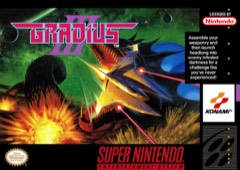
You fly the Vic Viper against the Bacterion Empire, left to right, one long stage after another. The power meter from Gradius is back: shoot down the right enemies, collect capsules, and spend them on speed, missiles, doubles, lasers, Options and a shield.
The new idea is Edit Mode. Instead of taking one of the fixed weapon sets, you build your own, mixing missile, double, laser, shield and special power-ups into a ship that suits how you play. Some weapons only exist in the fixed sets and some only in custom ones, so the choice carries a real cost.
Where it sits in history
Konami released Gradius III in Japanese arcades in December 1989. The Super Famicom version came out in Japan on 21 December 1990, and in North America it was one of the launch titles for the Super NES in 1991.
The home version is not a straight copy. It drops the arcade game's pseudo-3D stage and its crystal stage, moves the cell stage to the end with a new layout and music, adds a new high-speed stage with a boss called Beacon, and offers an easier difficulty and extra weapons. It also keeps the arcade game's slowdown. Unlike the arcade original, it lets you continue after losing every life, and tapping A sixteen times in a second on the options screen unlocks a harder Arcade difficulty. Wii owners got it on the Virtual Console in 2007.
Famicom Tsūshin's reviewers liked being able to adjust the difficulty; one thought it was not hard enough. IGN later placed it 45th in its top 100 SNES games, praising the visuals, environments and bosses.
How it plays today
Edit Mode is still the reason to play. Planning a ship before the first stage, then finding out in stage three whether you planned well, is a small and satisfying loop.
The slowdown is the elephant in the room. When the screen fills, the game halves its speed. Some find that ruins it; others treat it as a gift that buys time to dodge. Either way, it is part of the game, not a fault in your copy. Start on the easier setting, learn the stages, then turn it up.
Compared with
- Gradius: The NES original whose power meter Gradius III expands into a full Edit Mode.
- Super R-Type: Irem's 1991 SNES shooter, harder still: it slows to a near standstill when busy and has no checkpoints, so a death sends you back to the start of the stage.
- Parodius: Konami laughing at its own series: Gradius rules, four pilots in place of weapon sets, and an octopus among them.
Why it matters
Edit Mode is a question the game asks before it lets you play: who do you want to be in here? Ryan, Rigby and Przybylski found that games satisfy needs for competence, autonomy and relatedness, and that this predicts enjoyment and wanting to play again. Gradius III leans on the second. Your ship is a set of decisions you made, so a good run feels like proof that you know yourself.
And when the plan fails, it is your plan that failed, which is exactly why you start again.
Read: Who you are when you play →
- Ryan, R. M., Rigby, C. S., & Przybylski, A. (2006). The motivational pull of video games: A self-determination theory approach. Motivation and Emotion, 30(4), 344-360. doi:10.1007/s11031-006-9051-8
What you're levelling up
You have been training these without noticing. Here is how to do it on purpose, and where it pays off away from the couch. All the skills games teach →
Systems thinking
In the game. Edit Mode lets you build your own weapon set from missile, double, laser, shield and special. Some weapons only exist in the fixed sets and some only in custom ones, so every pick has a cost.
Do it on purpose. Build a custom ship and change one piece per run. Note what got better and what got worse by stage three.
Off the couch. Every job offer is a build: pay, commute, people, what you'll learn. Change one part and the rest shift, so weigh the whole thing.
Keeping your cool
In the game. When the screen fills, the game halves its speed. Treat it as time to think, not a reason to panic.
Do it on purpose. Next time it slows down, breathe out and pick your gap before you move. Loose thumbs, no jerking the ship.
Off the couch. When everything's coming at you at once, slow it down on purpose. Job interviews and arguments both go better at half speed.
Memory and routing
In the game. Start on the easier setting, learn the stages, then turn it up. Gradius rewards the pilot who knows what's coming.
Do it on purpose. Pick one stage and write down where every big threat appears. Fly it again and see what you missed.
Off the couch. Remember the little things your date mentioned, the café they love, their best mate's name, and bring them up later. It's the simplest way to show you actually listen.
Verdict · 7/10
A launch-day shooter that hands you the parts and lets you build the ship. Slow when busy, sharp everywhere else.