What it was
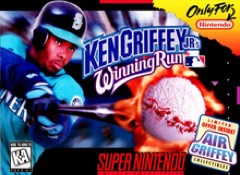
A baseball game for the Super NES and the follow-up to Ken Griffey Jr. Presents Major League Baseball. It has the 28 Major League teams of the day, a franchise mode, an MLB Challenge mode, single exhibition games and an All-Star mode with a home run derby. Play a full 162-game season and it unlocks the two teams that would join the league in 1998, the Tampa Bay Devil Rays and the Arizona Diamondbacks.
Nintendo had no licence from the players' union, so Griffey is the only player under his real name. Most stadiums are generic once the ball heads for the fence; from the batter's box some look right, but Wrigley Field loses its ivy at the wall. It was one of the first sports games with alternate uniforms: the computer picks home, away or a coloured alternate for each game.
Where it sits in history
Rare developed it and Nintendo published it in North America in June 1996. The name comes from the last play of the 1995 American League Division Series between the Seattle Mariners and the New York Yankees. In the bottom of the 11th, Griffey ran all the way home from first base to score the winning run on a close play, a moment sometimes credited with saving baseball in Seattle.
Reviews were warm. Electronic Gaming Monthly's sports reviewers saw better graphics and animation than the first game. Nintendo Power liked the graphics, the sound and the controls but counted the missing licence against it, while GamePro felt it stayed authentic anyway. IGN put it at 52 in its top 100 Super NES games in 2011. Promotional keychains came with a tiny baseball and a wooden bat printed with the title. Two years later Griffey had another game on the Nintendo 64.
How it plays today
Rare at the end of the Super NES knew how to make sprites move, and it shows. Swings and throws are smooth and the colour is rich. The controls are quick and the game keeps the arcade feel of the first one, so a single exhibition game is over in a sensible time.
The made-up names are the price. If you want to replay the 1996 season with real rosters, this is the wrong game. If you want a brisk, good-looking game of baseball, it holds up better than most from its era, and the full season with its secret expansion teams gives a long-term goal.
Compared with
Why it matters
A game named after one run around the bases is a game about a crowd. When Griffey slid home in 1995 a whole city stood up at once, and that charged, shared feeling of people caught up in the same moment is what binds them. Sport makes it on purpose, every week.
Winning Run tries to bottle a little of it. It can't give you the stadium, but it gives two friends on a couch the same thing at a smaller scale: a tied game in the late innings, both of you leaning forward, and someone yelling as the throw comes in.
Read: The second controller →
- Durkheim, E. (1912). The Elementary Forms of Religious Life.
What you're levelling up
You have been training these without noticing. Here is how to do it on purpose, and where it pays off away from the couch. All the skills games teach →
Winning and losing well
In the game. Couch games against a mate come down to one throw home in the late innings, and one of you has to lose it.
Do it on purpose. Play a mate best of three. The loser picks the next teams, and nobody's allowed to blame the controller.
Off the couch. Watching the footy with a date's family, cheering their team without sulking about yours. Being good company in the stands counts for heaps.
Planning ahead
In the game. There's a franchise mode, and a full 162-game season unlocks the Devil Rays and the Diamondbacks. That's a long-term goal on one cartridge.
Do it on purpose. Set a schedule: a few games a session until the season's done. Track it on paper and see whether you hold to it.
Off the couch. A big goal, a half marathon, a house deposit, gets done in small sessions on a schedule. Same as 162 games.
Keeping your cool
In the game. Late innings, tied game, the throw coming in. The controls are quick, so a panicky press costs you the run.
Do it on purpose. In a close ninth, take a breath between pitches and loosen your grip. Notice whether your swing gets cleaner.
Off the couch. A penalty kick, a big presentation, the last question in a job interview. One slow breath before you answer buys more than it costs.
Verdict · 8/10
Smooth, quick, handsome baseball from Rare's best years, with one real name on the field. One of the best ways to play ball on a Super NES.