What it was
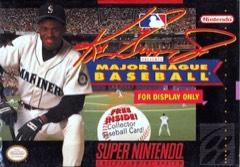
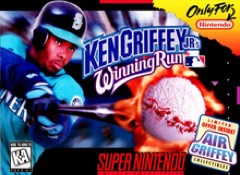
A baseball game for the Super NES with a strange licence. It had Major League Baseball's approval but not the players' union's, so it has every real team and most real ballparks, and only one real player: Ken Griffey Jr. Everyone else is invented, carrying the 1993 statistics of the real player they stand in for. A name editor lets you put the real names back.
The invented names are the joke. The Boston Red Sox are characters from Cheers, Norm Peterson and Sam Malone among them. The Baltimore Orioles pay tribute to John Waters films. The California Angels are old film stars: Bogart, Brando, Cagney, Wayne. The parks are built with care where the cartridge had room: Fenway's Green Monster, the warehouse beyond right field at Camden Yards, the waterfalls at Kauffman Stadium. Teams without their own park share a few generic ones.
A battery saves seasons of 26, 78 or 162 games, with playoffs and a World Series. Because the game came out after Major League Baseball had announced six divisions but before the first season played with them, you can choose either four or six.
Where it sits in history
Software Creations developed it and Nintendo published it in North America in 1994, with a Griffey collector's card in the box. A Game Boy version with real players followed in 1997.
Reviews were mixed. GamePro disliked the fake players, the loose ballparks and the way you could steer a pitch after it left the hand, but liked the music, the manual and how easy it was to pick up. Electronic Gaming Monthly found the computer too hard to beat alone and praised the digitised voices of umpire Steve Palermo and announcer Jack Buck. It sold anyway: 750,000 copies by July 1994 and 1.2 million in the end. Nintendo made three more Griffey games, and MLB The Show later added a Retro Mode modelled on this one.
How it plays today
It is quick, loud and easy to love. Pitching is simple, hitting has a satisfying crack, and a full game takes minutes. Against a friend it is a riot, and the bent pitches GamePro hated make the duel more fun, not less.
Treat a long season with caution. The game has real bugs: some home run totals reset to zero after the All-Star game, and saved seasons and edited names have been known to vanish. Play short seasons, or exhibition games, and enjoy reading the rosters.
Compared with
Why it matters
Gee describes the identity we take on in a game as a blend: part us, part the character, shaped by what we want that character to be. Ken Griffey Jr. hands you a league of strangers with real numbers and silly names and a box for typing in new ones. Who these players are is partly up to you.
That is why people still talk about the rosters. The team is the Red Sox, and also Norm from Cheers, and also whoever you decided to name after a friend or a hero. Baseball is a game of numbers; this cartridge made it a game of names too.
Read: Who you are when you play →
- Gee, J. P. (2003). What Video Games Have to Teach Us About Learning and Literacy.
What you're levelling up
You have been training these without noticing. Here is how to do it on purpose, and where it pays off away from the couch. All the skills games teach →
Timing and rhythm
In the game. Pitching is simple and hitting has a satisfying crack. Swing a beat early or late and it's a foul or a whiff.
Do it on purpose. Play an exhibition and let the first pitch of every at-bat go by just to read the speed. Swing from the second on.
Off the couch. Cricket, tennis, a joke at the pub. Watch the ball, don't rush, and the good contact comes.
Reading people
In the game. Against a friend, the bent pitches make the duel. Everyone has a favourite pitch they reach for when they're in trouble.
Do it on purpose. Over a game, note what your mate throws when they're behind in the count. Next game, sit on that pitch.
Off the couch. Notice what a date does when nervous, the fidget, the quick joke, the drink they keep picking up. That's your cue to slow down and ask an easier question, not push on.
Making things
In the game. Everyone but Griffey is invented, and a name editor lets you type in new names. The Red Sox are already Norm and Sam from Cheers.
Do it on purpose. Rename a whole team after your mates, matching each one to a player whose stats fit. Play a short season and see who they argue about.
Off the couch. Making something for your crew, a team, a playlist, a running joke, is how groups get their in-jokes. People remember who started it.
Verdict · 8/10
An arcade-light baseball game with a real league and a joke roster, buggy over a long season and great for an afternoon. Often named among the best baseball games ever, and fairly.