What it was
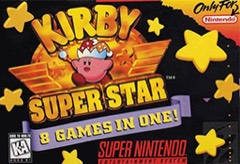
Think of it as a sampler. Instead of one long adventure, the cartridge holds a handful of short Kirby games plus two minigames. Spring Breeze squeezes the first Kirby game, Kirby's Dream Land, into a short remake. Dyna Blade sends Kirby after a giant bird. Gourmet Race is a sprint against King Dedede to eat the most food. The Great Cave Offensive is a treasure hunt through a cave with sixty chests to find, some holding jokes from other Nintendo games. Revenge of Meta Knight races the clock across a falling airship, and Milky Way Wishes, the biggest, sends Kirby across nine planets. The Arena is every boss in a row, on one life.
Kirby still inhales enemies and copies their powers, but each power now has a spread of moves, closer to a fighting game than a single attack. Better still, you can turn a power into a Helper, a partner the computer or a second player controls.
Where it sits in history
HAL Laboratory made it under Kirby creator Masahiro Sakurai, his third Kirby game as director, and Nintendo published it in Japan in March 1996, North America that September and Europe, as Kirby's Fun Pak, in January 1997. It arrived months before the Nintendo 64. Development took three years, partly because the team redrew the art midway after Donkey Kong Country changed expectations.
Sakurai built it on three ideas: co-op, fighting-game-style moves and an anthology format. The co-op came from Shigeru Miyamoto, who wanted it for Mario and judged Kirby's slower pace a better fit. The anthology was a response to long, expensive games; Sakurai wanted bite-sized ones that suited newcomers and veterans alike. It sold 1.44 million copies, and a DS remake, Kirby Super Star Ultra, followed in 2008.
How it plays today
It is as easy to pick up as anything on the SNES and much deeper than it looks. The copy abilities are genuinely fun to experiment with, the Helper system makes co-op work for a child and a parent or two old hands, and the modes are varied enough that you rarely feel stuck in a rut. Revenge of Meta Knight and The Great Cave Offensive are the standouts; the Gourmet Race theme has been remixed in Super Smash Bros. ever since.
The flip side of short modes is that some feel slight. Spring Breeze and Dyna Blade are over quickly, and seasoned players will find the challenge low until The Arena. Alone, you miss half the point. But as a game to play with someone else on the couch, it is one of the best on the console.
Compared with
- Kirby's Adventure: Sakurai's earlier NES Kirby, also built on copying enemy powers; Super Star gives each power a full moveset and a partner.
- Super Mario World 2: Yoshi's Island: The other late SNES platformer built on eating enemies; Yoshi's is a careful puzzle, Kirby's a romp.
- Donkey Kong Country: The game that pushed HAL to redraw its art midway; glossier, but nowhere near as generous with modes.
Why it matters
Kirby Super Star hides a quiet piece of genius. Turn a copy ability into a Helper, hand the second pad to someone, and now there are two of you. The co-op came from Shigeru Miyamoto, and Masahiro Sakurai shaped the whole cartridge so newcomers and veterans could share it. Picture a parent and a child on one couch: one player brilliant, the other barely steering, both needed.
Richard Ryan, Scott Rigby and Andrew Przybylski found games satisfy needs for competence, autonomy and relatedness, and that this predicts enjoyment and wanting to play again. Most games feed the first two. Kirby Super Star is unusually good at the third. It is hard to feel alone in Gourmet Race with someone beside you, laughing as King Dedede out-eats you both. Short modes, long life, and nearly always a second person in the memory.
Read: The second controller →
- Ryan, R. M., Rigby, C. S., & Przybylski, A. (2006). The motivational pull of video games: A self-determination theory approach. Motivation and Emotion, 30(4), 344-360. doi:10.1007/s11031-006-9051-8
What you're levelling up
You have been training these without noticing. Here is how to do it on purpose, and where it pays off away from the couch. All the skills games teach →
Teamwork
In the game. Turn a copy ability into a Helper and suddenly there are two of you. The good runs come from one player clearing enemies while the other handles the boss.
Do it on purpose. Play Revenge of Meta Knight with a mate and agree out loud before each room who's doing what. Notice how much faster it goes when you stop overlapping.
Off the couch. Group assignments, a shared house, cooking dinner with someone. Splitting the job cleanly beats two people doing the same half.
Curiosity
In the game. The Great Cave Offensive hides sixty treasure chests, some holding jokes from other Nintendo games. You only find them by poking into every odd corner.
Do it on purpose. Play one area of the Cave with a rule: check every wall and ledge before moving on. Tally how many chests you'd have walked past.
Off the couch. Ask the follow-up question. Curious people are bloody good company on a date, because asking what someone actually means beats waiting to tell your own story.
Bouncing back
In the game. The Arena is every boss in a row on one life. You will lose a long run to a dumb mistake near the end.
Do it on purpose. After each failed Arena run, write down the boss that got you and one thing you'll do differently. Go again straight away.
Off the couch. A knock-back on a job, a rejected pitch, a bad week at training. Write down what went wrong, then line up again. That's the whole trick.
Verdict · 9/10
A generous, playful anthology and one of the SNES's best games for two. Short modes, long life.