What it was
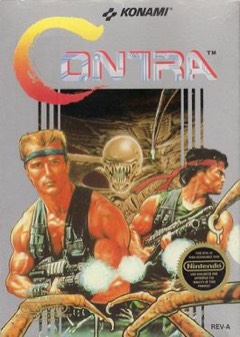
Two commandos, Bill and Lance, run left to right through a jungle, up a waterfall, across a snowfield and into an alien lair, shooting everything that moves. That is Contra, and it barely needs more explanation than that. One hit kills you. A falcon-shaped capsule floats past with a letter on it, you shoot it open, and your rifle becomes a machine gun, a laser, a corkscrewing fireball or the spread gun that fires five shots in a fan.
The NES version breaks up its side-scrolling with two base stages seen from behind, where you push into the screen through corridors of walls and turrets. Two players can play at once, and when one runs out of lives they can borrow from the other's stock.
Where it sits in history
Konami made Contra for arcades in 1987, and it became one of the top four highest-grossing dedicated arcade games in the United States that year. The home version followed in February 1988, both in Japan on the Famicom and in North America on the NES. Konami did not simply shrink the arcade game. It rebuilt the seven arcade stages into eight, dropped the maze layouts and timers from the base stages, and turned the arcade's long final stage into four stages of their own.
The two releases differ. The Famicom cartridge used Konami's own VRC2 chip, which let it add animated backgrounds, cutscenes between stages and a map of the islands. The NES version ran on a cheaper board with half the ROM and lost those touches. Europe waited until December 1990 and got Probotector, with the soldiers redrawn as robots to get past German restrictions on violent games.
It sold two million copies, Electronic Gaming Monthly named it the best action game of 1988, and it carried the Konami Code: enter it at the title screen and you start with thirty lives instead of three.
How it plays today
It is still tremendous fun with a friend on the couch. The eight-way aim, the somersault jump and the spread gun give you a lot of control for such a plain pad, and the stages move quickly enough that dying and restarting never drags. Learning where each turret and sniper appears is the whole skill, and the game rewards it fast.
Played alone and without the code, it is hard in the old way: one touch and you lose your weapon along with the life. The behind-the-back base stages have aged the worst; they are slower and less readable than the rest. With thirty lives and a second player, few NES games are more immediate.
Compared with
- Super C: The NES sequel swaps the into-the-screen base stages for top-down ones and is tighter as a result, if less surprising.
- Contra III: The Alien Wars: The SNES game is bigger, louder and harder, with set pieces the NES could not attempt.
- Life Force: Konami's other co-op shooter on the NES, with the same habit of punishing a single mistake by stripping your power-ups.
Why it matters
Contra is secretly a game about lending. When one player runs out of lives, they can borrow from the other's stock, and anyone who has shared a couch and a Contra cartridge knows the negotiation that follows. Even the Konami Code, thirty lives instead of three, became something to share.
Erving Goffman wrote that a game creates a shared world with its own rules of relevance, and that engrossment together is what makes an encounter feel alive. Contra shows it plainly. For half an hour nothing outside the screen counts: only the spread gun, the waterfall, and who covers the top of the screen. Emile Durkheim called the charged, shared energy of people gathered in one activity collective effervescence, and said it binds them. That is the yell when the last boss finally goes down. One hit kills you in Contra, which is exactly why a second player beside you matters. It plays better shared, and it knows it.
Read: The second controller →
- Goffman, E. (1961). Encounters: Two Studies in the Sociology of Interaction ('Fun in Games').
- Durkheim, E. (1912). The Elementary Forms of Religious Life.
What you're levelling up
You have been training these without noticing. Here is how to do it on purpose, and where it pays off away from the couch. All the skills games teach →
Memory and routing
In the game. Learning where each turret and sniper appears is the whole skill, and the game rewards it fast. One hit kills you.
Do it on purpose. Write down where every sniper is in the jungle stage from memory. Play it and see what you missed.
Off the couch. Names, faces, what people told you last time. Remembering is a superpower at work and on a second date.
Teamwork
In the game. Two players at once, and when one runs out of lives they can borrow from the other's stock. Still the first cartridge to reach for when a mate picks up the second controller.
Do it on purpose. Give your lives to your mate when they're struggling and see how far the run goes. Talk the whole way.
Off the couch. Sharing the load when a mate's going through it is what makes you a good mate. It's also what makes you good to date.
Hand-eye coordination
In the game. Eight-way aim, a somersault jump and the spread gun give you heaps of control on a plain pad.
Do it on purpose. Play a stage without the spread gun. Every shot aimed, no spraying.
Off the couch. Sport, driving, catching a dropped glass before it hits the floor. Quiet competence reads as confidence.
Verdict · 9/10
The benchmark for two-player action on the NES, and still the first cartridge to reach for when a friend picks up the second controller. Play the Famicom version if you can; it is the more complete one.