What it was
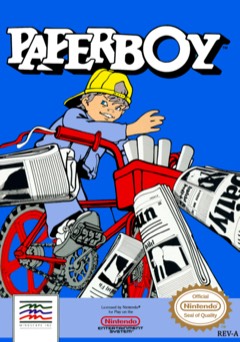
The NES version of Atari's 1985 arcade hit. You ride a bicycle down a suburban street, seen from a slanted overhead angle, and throw newspapers. In the arcade original, ten of the twenty houses take The Daily Sun and are painted bright so you can spot them; you land a paper on the porch or in the letterbox, and you dodge cars, skateboarders, dogs and worse.
The rest of the street is fair game. Breaking a non-subscriber's windows earns points. Miss a subscriber, or break their window, and they cancel. Each level is a day of the week, Monday to Sunday, and after each route comes a training course of ramps and targets. The game ends when you run out of lives or customers.
Where it sits in history
Dave Ralston pitched the idea at Atari in February 1983, drawing on his own paper round, and sketched it on a cocktail napkin. Early versions had giant snails, ducks in business suits and rolling pianos. Focus groups disliked all of it except an old lady with a shopping trolley, so the team rebuilt the street from real life: bullies, burglars, joggers, breakdancers, cats and bees, with the Grim Reaper kept. The arcade cabinet used bicycle handlebars.
The NES port came late. It was shown at the Summer Consumer Electronics Show in 1988 as a last-minute replacement for a planned NES version of Bad Street Brawler. Eastridge Technology developed it and Mindscape published it in the United States in December 1988; it reached the United Kingdom by March 1991. Reviews split. Mean Machines called it an offensive conversion of a classic, while AllGame thought Mindscape had done a good job, liking the controls and sound effects but not the music.
How it plays today
On a d-pad, without the handlebars, Paperboy loses some of its charm, and the angled street is hard to read at speed: you will hit fences you thought were behind you. The throws want practice, because you aim at a porch you are already passing.
Yet the idea is still funny and still good. Delivering to the right houses and wrecking the wrong ones gives every run two jobs at once, and losing customers one by one is a gentle, clear way to fail. Play it for a few days of the week at a time, not in one long sitting.
Compared with
- Paperboy 2: The sequel, also ported to the NES by Eastridge Technology.
- Excitebike: Nintendo's own ramps-and-crashes bike game, tighter on a controller.
- Skate or Die!: Another late-80s NES street game about kids on wheels.
Why it matters
Paperboy takes a job children did for pocket money and makes it a game. Huizinga described play as a circle set apart from ordinary life, with its own order. Inside this circle a paper round becomes a contest, and the same street gets new rules: some houses are customers, the rest are targets. Ralston drew it from his own memories of the round.
Suits defined playing a game as 'the voluntary attempt to overcome unnecessary obstacles'. Nobody needs to dodge a breakdancer to deliver a paper. Put the obstacles there on purpose, though, and the most boring chore of a childhood becomes something children paid to do.
Read: The magic circle: the world that rules make →
- Huizinga, J. (1938/1949). Homo Ludens: A Study of the Play-Element in Culture.
- Suits, B. (1978). The Grasshopper: Games, Life and Utopia.
What you're levelling up
You have been training these without noticing. Here is how to do it on purpose, and where it pays off away from the couch. All the skills games teach →
Timing and rhythm
In the game. You aim at a porch you're already passing. The throw has to leave a beat early or it sails past.
Do it on purpose. Ride Monday focusing only on when you release the paper. Count how many land in the letterbox.
Off the couch. Leading the target, thinking where things will be, not where they are, works in sport and in asking for things at the right moment.
Judging risk
In the game. Breaking a non-subscriber's windows earns points, but miss a subscriber or break their window and they cancel. Every run has two jobs.
Do it on purpose. Play one day ignoring vandalism and only keeping customers. Then play one going for points. See which lasts longer.
Off the couch. Chasing the fun points while losing the real customers is how small businesses go under. Keep the people who pay you.
Bouncing back
In the game. Losing customers one by one is a gentle, clear way to fail, and you will hit fences you thought were behind you.
Do it on purpose. Play a few days of the week at a time and aim to finish with one more customer than last time.
Off the couch. A slow slide is easier to fix than a crash. Notice the small losses, at work or with a mate you haven't called, and fix them early.
Verdict · 6/10
A rough port of a brilliant arcade idea: a chore turned into a game, with a licence to vandalise. Worth a few rounds, not a long stay.