What it was
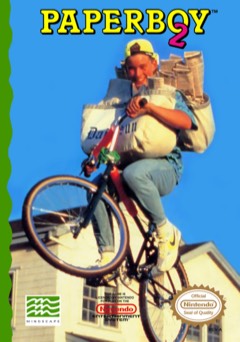
The sequel to Paperboy, made for home systems only. You ride a bike down a street and throw the morning paper to your customers while the neighbourhood tries to knock you off: tyres rolling down a driveway from a car under repair, a haunted house, and stranger homes. This time you can play as a paperboy or a papergirl, and the papers go to houses on both sides of the street, not just one.
Somewhere in the middle of each stage are four special things to do, and each puts your photo on the next day's front page. Break a window and the headline reads 'Mysterious Vandalism Baffles Police'. Hit an armed robber at a petrol station in the back with a paper, or stop a runaway pram, and you are a hero, rewarded with lollies by a happy policeman.
Where it sits in history
Eastridge Technology made the NES version and Mindscape published it, in North America in April 1992 and in PAL regions on 6 June 1992. It came out across 1991 and 1992 on almost everything: Amiga, Amstrad CPC, MS-DOS, Game Boy, Game Gear, Genesis, Super NES and ZX Spectrum as well.
Reviewers were rough on it. N-Force gave the NES version 42 per cent. Total! gave it 50 out of 100 and complained about the camera, the controls, the music and the play itself. The other versions did little better, though Power Unlimited liked the Game Gear version and called it one of the most American games ever made.
How it plays today
The headlines are the best idea in it, and a good reason to try. Hunting for the four moments in each street turns a delivery round into a small treasure hunt, and the vandalism headline is a proper laugh.
The rest is hard going. Like the first game it is known for being difficult, and throwing to both sides of the road makes every house a choice between left and right while the obstacles keep coming. The camera, which Total! complained about, leaves little time to see what is coming. Play the first Paperboy for the ride and this one for the jokes, briefly.
Compared with
Why it matters
Paperboy 2 has a sense of humour about what happens when you fail on purpose. Break a window and you get your face in the paper, the same as for catching a robber. Jesper Juul calls it the paradox of failure: in most of life we work hard to avoid failing, yet in games we seek it out, and failing makes us look again and try something new.
Here the game pays you for poking at its edges. A paper through a window is a story, not just a mistake. That is the paradox in miniature: the most remembered thing in a hard, unloved game is the moment it rewarded getting it wrong.
Read: One must imagine Mario happy →
- Juul, J. (2013). The Art of Failure: An Essay on the Pain of Playing Video Games. MIT Press.
What you're levelling up
You have been training these without noticing. Here is how to do it on purpose, and where it pays off away from the couch. All the skills games teach →
Judging risk
In the game. Papers go to houses on both sides of the street, so every house is a choice between left and right while the obstacles keep coming.
Do it on purpose. Ride one street choosing only the safest throw at each house. Compare your score to an all-in run.
Off the couch. You can't do everything at once. Picking the safe win over the flashy miss pays off at work and with money.
Curiosity
In the game. Four special moments in each street put your photo on the front page, from stopping a runaway pram to bagging an armed robber.
Do it on purpose. Replay a stage hunting only the headlines. Ignore the score and see how many you can find.
Off the couch. The odd detour often makes the best story. Having a good yarn at the pub starts with noticing things.
Hand-eye coordination
In the game. The camera leaves little time to see what's coming, and you're steering a bike and throwing at the same time.
Do it on purpose. Slow down and focus on throwing accurately at one side for a whole street. Then add the other side.
Off the couch. Learning one hand at a time then putting them together works for guitar, driving and cooking for a crowd.
Verdict · 4/10
A few great front pages stuck to a hard, cramped delivery game. Worth a look for the headlines, not for the ride.