What it was
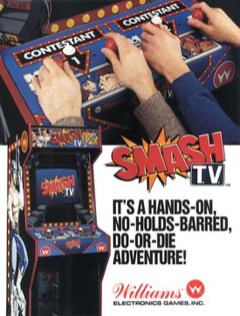
It's 1999 and you're a contestant on the most violent game show of all time. You're locked in a single-screen arena, enemies pour in through doors on all four walls, and you shoot your way through while grabbing cash, power-ups and gift-wrapped prizes like toasters and VCRs. Clear the room, pick an exit, do it again. Sooner or later there's a boss, and the last one turns out to be the host himself.
The arcade original came out in 1990 from Williams Electronics. Eugene Jarvis designed it and Mark Turmell programmed it, and it plays like a descendant of Jarvis's 1982 Robotron: 2084: twin-stick shooting, one screen at a time. The difference is that Smash TV's enemies arrive in waves rather than being on screen from the start. The NES version is a port, developed by Beam Software for Acclaim and out in North America in September 1991, with a PAL release the same year.
Where it sits in history
The arcade game's host is half the show. His catchphrases ("Total carnage! I love it!", "I'd buy that for a dollar!") punctuate everything. The script came from Jon Hey, who also did the composing and sound design, and Paul Heitsch voiced the host. The game borrows its mood from dystopian films like RoboCop and The Running Man.
There's a good bit of arcade trivia too. The game shipped without its bonus level, the Pleasure Dome, because the designers figured not enough players would reach the end. Players who did reach it complained to arcade operators that there was nothing there, so Williams sent out a revised game that included it. Smash TV was named most innovative game by the Amusement and Music Operators Association in 1990, and later made lists from Electronic Gaming Monthly and GameSpot.
Smash TV came to a pile of home systems: the NES, Super NES, Game Gear, Master System and Genesis, plus Ocean's versions for the ZX Spectrum, Commodore 64, Amstrad CPC, Atari ST and Amiga. The NES one came from Beam Software, the Melbourne studio that went on to make Shadowrun. The arcade original later turned up on Midway Arcade Treasures in 2003 and Midway Arcade Origins in 2012.
How it plays today
The idea holds up because it's so simple. Move one way, shoot another, keep the doors in your head, and don't let the crowd corner you. Rooms are short, the loop is quick, and you always want one more go. It's a game about staying calm while the screen fills up.
Fair warning: this is a port of an arcade game built to eat coins, so expect to lose a lot. If you can get a mate on the couch, two players work together, and the end-of-level bonus for whoever grabbed the most cash and prizes keeps it honest. Play it in short bursts and it's a belter.
Compared with
- Super Smash TV: The SNES version. Its four face buttons are laid out like a D-pad, so you can shoot one way while running another.
- Total Carnage: A 1992 Williams arcade game named after the host's catchphrase. It plays like Smash TV and Turmell programmed it, but it's not a sequel.
Why it matters
A room full of enemies, a crowd that wants a show and a host cheering you on. Smash TV is a game about performing under pressure, and it knows it. Everything is turned up. Everyone's watching. You're just trying not to get surrounded.
Émile Durkheim wrote about collective effervescence, the charged energy that shows up when a group is gathered around one activity. A couch full of mates yelling at a screen as two players dodge the same wave is a small version of it.
Read: The second controller →
- Durkheim, E. (1912). The Elementary Forms of Religious Life.
What you're levelling up
You have been training these without noticing. Here is how to do it on purpose, and where it pays off away from the couch. All the skills games teach →
Hand-eye coordination
In the game. Move one way, shoot another. The arcade gives you two sticks for it, and some home versions let a second pad's D-pad do the aiming, so each hand has its own job.
Do it on purpose. Play a full level only shooting while you're moving, never standing still.
Off the couch. Cooking a feed while chatting. Driving and changing the song. Two things at once without dropping either.
Keeping your cool
In the game. Enemies pour in through doors on all four walls in waves. The room gets loud and you've got to keep thinking.
Do it on purpose. Count to three before you pick your next exit. Don't just bolt for the first one.
Off the couch. Deadlines, a full pub on a Friday, a tricky conversation. Staying level while it gets busy is a skill.
Judging risk
In the game. Cash and prizes are scattered through the arena, and every one you grab is a step towards the crowd.
Do it on purpose. Pick a prize you're going to skip on purpose and see if you live longer.
Off the couch. Knowing when the bargain isn't worth the detour. Money, mates, and the odd bad idea.
Verdict · 7/10
A quick, loud, wave-after-wave shooter that suits short sessions. The idea is brilliant. The port is a port.