What it was
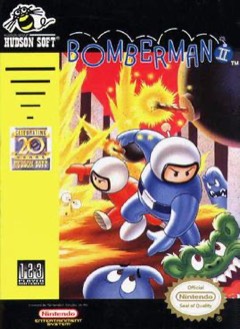
Black Bomber robs a bank and frames Bomberman for it, and Bomberman lands in prison. The way out is the way Bomberman always gets anywhere: plant bombs, blow up the blocks and the guards in each room, and find the door hidden under one of the blocks. Other blocks hide power-ups that widen your blast or make your bombs go off sooner.
It plays the classic Bomberman way and is built directly on the 1990 Bomberman. After a game over, you get a password that remembers your level, your number of bombs and their strength, so you can pick up where you left off.
The bigger change is company. Vs Mode puts two players against each other, and Battle Mode takes three, if you have the NES Four Score adaptor. Every player is a Bomberman, and the only goal is to be the last one standing.
Where it sits in history
Hudson Soft developed and published it. It came out on the Famicom in Japan on 28 June 1991, in Europe and Australia the same year as Dynablaster, and in North America in February 1993.
In Famitsu, one reviewer warned that the PC Engine version let more people play at once and another missed its larger playfield, but they still found the battles great fun. Nintendo Power called the graphics and sound primitive and said it did not matter, because the multiplayer was so much fun.
It was re-released in 2005 on the Game Boy Advance in Hudson Best Collection Vol. 1: Bomberman Collection, alongside the first NES Bomberman, and the Japanese version is part of the 2026 Super Bomberman Collection.
How it plays today
The solo game is honest work: tidy rooms, steady power-ups and a password so you never lose too much. It is the original Bomberman with a reason to be there.
Battle Mode is why you would find a copy now. Three players with a Four Score is a fine Friday night. The SNES games added more players and arenas later, but this is a good place to start.
Compared with
Why it matters
Huizinga described play as a space set apart from ordinary life, with its own order and its own rules, a magic circle you step into on purpose. Bomberman's grid is one of the clearest you will find. Inside it, a friend is an opponent and every block is a choice, and the moment the round ends you are just two people on a couch again.
That is what makes it safe to trap someone you love in a corner and laugh about it. The circle holds the rivalry, so the friendship does not have to.
Read: The magic circle: the world that rules make →
- Huizinga, J. (1938/1949). Homo Ludens: A Study of the Play-Element in Culture.
What you're levelling up
You have been training these without noticing. Here is how to do it on purpose, and where it pays off away from the couch. All the skills games teach →
Reading people
In the game. Battle Mode with three players and a Four Score, last Bomberman standing. Your mates have habits: one always rushes, one always hides in a corner.
Do it on purpose. Spend one round just watching. Name each mate's habit out loud, then trap them with it next round.
Off the couch. Knowing who in the group needs a nudge and who needs space makes you the one people like having around. Watch first.
Winning and losing well
In the game. Battle Mode is a fine Friday night, and bombing a mate into a corner is always going to cause a bit of lip.
Do it on purpose. When you're well ahead, try winning a round with only one bomb. Keep it fun for everyone.
Off the couch. Gloating wins you nothing but a smaller group chat. Gracious winners get asked back, by mates and by dates.
Planning ahead
In the game. Find the exit under a block while keeping clear of your own blast. The password saves your bomb count and strength, so every power-up you grab is a choice that sticks.
Do it on purpose. Before dropping a bomb, say where you'll stand when it goes off. If you can't name it, don't drop it.
Off the couch. Know your escape route before you light the fuse: leaving a job, signing a lease, starting a big project. Planning the exit is part of the plan.
Verdict · 7/10
A tidy solo game with a password and a jailbreak story, and a Battle Mode for three friends. That second part is what lasts.