What it was
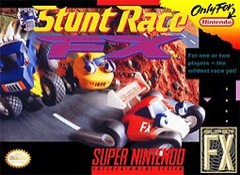
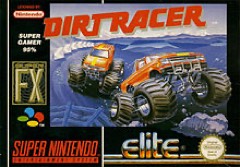
A racing game built from polygons on a console that was never meant to draw them. You pick a car with eyes for headlights: the F-Type, a Formula One racer; the Coupe; or the 4WD, a monster truck. A fourth, the 2WD, unlocks later, and a semi-trailer called the Trailer turns up in the bonus games. Each one trades speed, toughness and acceleration differently.
Every course is made of 3D shapes, with bumps in the road, overpasses and billboards. Collisions damage your car, a boost button gives you a burst of speed, and L and R tighten your turns. Around the racing sit an obstacle course, a test drive, time attack and a multiplayer race.
Where it sits in history
Nintendo and Argonaut Software started building the Super FX chip in 1991 so the Super NES could draw polygons. Star Fox was the main goal, but the two teams also tried other 3D ideas, and one of them, first called FX Trax, grew into this game once Giles Goddard and Colin Reed joined. It became the second game to use the chip. In Japan it is Wild Trax, released on 4 June 1994; North America got it in July and PAL regions on 27 October.
Shigeru Miyamoto produced it and asked for cars that behave like real ones. The F-Type carries its weight at the back, so its tail slides out in corners more easily than the others. The eyes went on late in development, and an early three-wheeler, the 3WD, was dropped for the 2WD.
Famitsu counted 161,995 copies sold in Japan, and PC Zone reported in 1998 that worldwide sales had passed a million. Edge called it one of the best racers on any home system; Electronic Gaming Monthly found the steering touchy and missed any sense of speed after Star Fox.
How it plays today
Both reviews were right. The chip cannot move much quickly, so the designers made the cars heavy and clumsy on purpose, and it shows: this is a game about wrestling a truck over a hump, not about flying. The blocky early polygons can make some players queasy.
What still lands is the personality. The cars have faces, the tracks feel handmade, and the 4WD on a rough course has real weight to it. Play it in short sessions, start with the truck, and treat it as a postcard from the moment 3D arrived on the living-room console.
Compared with
- Star Fox: The first Super FX game, from the same partnership, and the one Stunt Race FX was measured against.
- Super Mario Kart: Nintendo's other SNES racer, and the quicker, livelier choice for two players.
- F-Zero: Pure speed with no polygons at all, the opposite trade.
Why it matters
Stunt Race FX shows a team turning a limit into a feel. Suits called playing a game 'the voluntary attempt to overcome unnecessary obstacles', and here the obstacle is the machine itself: a chip too slow for speed, so the designers built a world of lumbering cars where slowness is the point. You accept the rule, and the rule becomes the game.
That is a very human trick. We do it with every constraint we cannot change, and sometimes, as here, the result has a face and blinks at you.
Read: The magic circle: the world that rules make →
- Suits, B. (1978). The Grasshopper: Games, Life and Utopia.
What you're levelling up
You have been training these without noticing. Here is how to do it on purpose, and where it pays off away from the couch. All the skills games teach →
Judging risk
In the game. The F-Type, Coupe and 4WD trade speed, toughness and acceleration differently, and collisions damage your car. Pick your weakness.
Do it on purpose. Run the same course in each car. Note where each one loses time and pick the car to suit the track.
Off the couch. Choosing what you're willing to trade, speed for safety, cash for time, is most money decisions you'll ever make.
Spatial thinking
In the game. Every course is built from 3D shapes, with bumps, overpasses and billboards. Reading a polygon road is a real skill.
Do it on purpose. Do the obstacle course until you can clear it without a scratch. Then try time attack.
Off the couch. Reading a road, a ski run or a crowded room at a glance is the same skill. It makes you steady when everyone else hesitates.
Bouncing back
In the game. The cars are heavy and clumsy on purpose, so you'll wrestle a truck over a hump, crash, lose your bearings and go again.
Do it on purpose. Start with the 4WD truck. Every time you crash, go again and change only your speed into that corner.
Off the couch. Not everything comes easy. Sticking with a clumsy new skill, a sport or a job, until it clicks is half of getting good.
Verdict · 6/10
A clever answer to a slow chip: if the cars cannot be fast, make them heavy. More charming than fun, and worth a look for that alone.