What it was
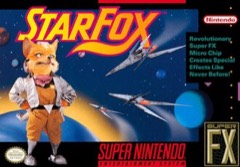
Fox McCloud and his wingmen, Falco, Peppy and Slippy, fly Arwing fighters through the Lylat system to stop the mad scientist Andross. It is a rail shooter: the game pushes you forward through each level while you steer, boost, brake and blast whatever flies at you, then face a boss at the end.
Three routes through Lylat, each a step up in difficulty, all start at Corneria and end at Venom. Your wingmen fly into view at scripted moments calling for help; save them and they pick off enemies and add to your score, ignore them and they can be shot down for the rest of the run. Scrape the scenery too often and your wings snap off, and your ship handles worse for it.
Where it sits in history
Star Fox grew out of Nintendo's partnership with the British studio Argonaut Software, whose NES prototype came from their earlier game Starglider. Argonaut's Jez San told Nintendo the SNES could do no better without extra hardware, so his team designed the Super FX chip, which rode inside the cartridge. Shigeru Miyamoto and Katsuya Eguchi led the design, Takaya Imamura drew the animal cast, and the torii gates of the Fushimi Inari shrine near Nintendo's Kyoto office inspired the rings you fly through.
It was released in 1993, as Starwing in PAL regions. Nintendo sold 1.7 million copies in Japan and the US by the end of March that year, the fastest North American launch to that point, and passed four million by 1998. Miyamoto has said the experience fed directly into Super Mario 64. A sequel, Star Fox 2, was made but stayed unreleased until 2017.
How it plays today
The sense of occasion survives. Flying over Corneria in flat-shaded polygons still has a strange, toy-like charm, the music is bold and memorable, and the chatter from your wingmen gives it personality most shooters lacked.
The frame rate is the problem. The Super FX was pushing hard, and the game often runs at what feels like a slideshow, which makes dodging less precise than it should be. Levels are short, and a practised player will finish a route in one sitting. The three routes add replay value, and the hardest one is a real test, but Star Fox 64 did almost everything here better.
Compared with
- Stunt Race FX: The other Super FX showcase from Nintendo, racing instead of shooting, with the same chunky polygons and low frame rate.
- Axelay: A traditional SNES shooter that fakes depth with sprite effects; smoother and faster, but flat by comparison.
- F-Zero: Nintendo's earlier trick for depth on the SNES, Mode 7 rather than polygons. Smoother, and it has aged more gracefully.
Why it matters
The rings you fly through in Star Fox came from the torii gates of the Fushimi Inari shrine, near Nintendo's Kyoto office. Someone walked under very old gates and thought: a spaceship should do that. So a 1993 polygon shooter carries a shape people have been passing through for centuries.
Johan Huizinga argued that play is older than culture, and that people mark off a magic circle for it, set apart from ordinary life with its own order. Star Fox is built from borrowed circles: shrine gates, a cast of talking animals, wingmen calling for help like kids on a backyard mission. Almost nothing in it was new except the chip in the cartridge. That is not a knock. The newest technology of its day went straight to one of the oldest things we do, which is pretend. The slideshow frame rate has aged. The urge to fly through a gate and see what waits on the other side has not.
Read: Older than us: play before people →
- Huizinga, J. (1938/1949). Homo Ludens: A Study of the Play-Element in Culture.
What you're levelling up
You have been training these without noticing. Here is how to do it on purpose, and where it pays off away from the couch. All the skills games teach →
Teamwork
In the game. Falco, Peppy and Slippy call for help at scripted moments. Save them and they pick off enemies; ignore them and they're gone for the run.
Do it on purpose. Play a route with one rule: never lose a wingman. Notice what you have to give up to make it happen.
Off the couch. Looking out for your crew pays you back later, at work, on a team or with mates. People remember who had their back.
Judging risk
In the game. Three routes through Lylat, each a step up in difficulty. Scrape the scenery too often and your wings snap off.
Do it on purpose. Clear the easy route without losing a wing, then step up. Don't move on until you can.
Off the couch. Climbing a level at a time, at work, in sport or in a relationship, beats jumping in over your head.
Hand-eye coordination
In the game. Steering, boosting and braking through rings while blasting what flies at you. The frame rate is choppy, so your hands have to read ahead.
Do it on purpose. Fly a level aiming to hit every ring. Count your misses and try to halve them.
Off the couch. Good hand-eye pays off in sport, driving and any job with tools. Being handy is a good look.
Verdict · 7/10
A landmark that proved the SNES could do real 3D, and still fun in short bursts. The frame rate keeps it from being more than that today.