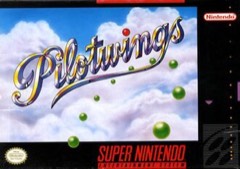
What it was
No villains for most of it, no race, no enemies. You join a flight club and try to earn licences across four training areas, each with a handful of events you can take in any order: a light plane, a hang glider, a skydive and a rocket belt. Each has its own controls. Fly through the rings or markers, then land as close to the target as you can, and instructors score you on time, accuracy and landing.
Pass all four areas and the game swerves: your instructors have been kidnapped, and you fly an attack helicopter onto a hostile island to rescue them, with anti-aircraft guns that kill in one hit. Then you do it all again in bad weather. Hidden bonus stages include steering a diving penguin into a pool.
Where it sits in history
Nintendo EAD made it under producer Shigeru Miyamoto, as one of three games, with Super Mario World and F-Zero, finished within 15 months of the system's debut. It came out in Japan on 21 December 1990, a month after the Super Famicom, and was a North American launch title in August 1991; Europe got it in 1992. Soyo Oka wrote the score, with Koji Kondo on sound programming and the helicopter theme.
It exists to show off Mode 7, the SNES feature that rotates and scales a flat image to fake depth. A flight demo called Dragonfly had shown the same trick at the console's unveiling in 1988. Critics called the result stunning, and it sold over two million copies by 1995. Sequels followed on Nintendo 64 and 3DS.
How it plays today
Pilotwings is at its best as a slow, focused test. The physics feel weighty for a 1990 game, the hang glider riding thermals is still quietly lovely, and nailing a dead-centre landing is a proper thrill. Oka's music is relaxed and memorable. It plays nothing like other SNES games, which is much of its appeal.
The trick behind it is also its limit. Buildings and trees are painted flat on the ground, so they seem to rise out of the floor as you fly over, and at height the world looks like a map on a table. There are only a few events, and the later licences mostly ask for more precision rather than anything new. Progress is saved by password. Give it an hour and you will know whether you are hooked; some players never are.
Compared with
- F-Zero: The same launch team and the same Mode 7 showcase, spent on speed rather than precision.
- Super Mario Kart: Mode 7 again, this time on the ground with a second player alongside.
- Super Mario World: Finished by the same team in the same 15-month window; one sells the SNES on its platforming, the other on its tricks.
Why it matters
There is no reason to land a skydive on a bullseye. For most of Pilotwings nobody chases you, nothing is on fire, and the prize is a licence from a flight club that does not exist. People spend whole evenings on it anyway. The philosopher Bernard Suits defined playing a game as 'the voluntary attempt to overcome unnecessary obstacles'. Pilotwings may be the clearest case on the SNES: the obstacles are rings in the sky and a target painted on the ground, and you choose them.
Take the obstacles away and there is nothing left but someone falling out of a plane. Keep them, and the fall becomes a question of skill, nerve and a few metres of grass. A hang glider riding thermals over a flat Mode 7 world is a lovely answer to why we bother: calm, precise and pointless in the best way. Nobody needs to land dead centre. We want to, and the wanting is ours.
Read: The magic circle: the world that rules make →
- Suits, B. (1978). The Grasshopper: Games, Life and Utopia.
What you're levelling up
You have been training these without noticing. Here is how to do it on purpose, and where it pays off away from the couch. All the skills games teach →
Deep focus
In the game. Fly through rings, then land as close to the target as you can. Nailing a dead-centre landing takes total concentration.
Do it on purpose. Do one event five times in a row with your phone in another room. Chase a better landing score each go.
Off the couch. Being fully present is rare. At work it gets the job done, and on a date it's the most flattering thing you can do.
Spatial thinking
In the game. The hang glider rides thermals and the skydive drifts in the wind. You're judging height and distance in a world that looks like a map on a table.
Do it on purpose. Before each skydive, pick the spot you'll open the chute. Afterwards, check how close you got.
Off the couch. Judging distance and angle helps with parking, sport and working out if that couch really fits through the door.
Keeping your cool
In the game. Anti-aircraft guns kill in one hit on the helicopter mission, and the later licences ask for more precision under the same pressure.
Do it on purpose. When you're coming in to land, slow your breathing and your thumbs on purpose. See if it helps your score.
Off the couch. Steady hands under pressure count in exams, interviews and the first time you meet your partner's mates.
Verdict · 7/10
A calm, demanding and very specific game, one of the SNES's early tech showpieces. If landing a skydive on a bullseye sounds fun, it still is.