What it was
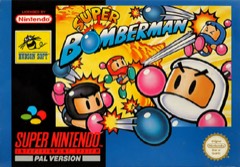
Four players, one screen, a grid of blocks and a lot of bombs. That is Battle Mode, and it is the reason this game is remembered. Drop a bomb, run, and let the cross of flame clear walls, catch rivals or set off other bombs in a chain. Power-ups hidden in the walls add range, more bombs or speed. One touch of fire and you are out. After ninety seconds the game shouts Hurry Up and starts sealing the arena from the edges in, which ends most stalemates in panic.
There is a story mode too: six worlds of eight stages each, where you clear enemies and find an exit hidden under a wall, alone or with a second player. A villain called Carat Diamond wants Bomberman's combat skills for his robot tournament, which is about as much plot as the game needs.
Where it sits in history
Produce! developed it and Hudson Soft published it in 1993. It was the first Bomberman to keep the name in Europe, where earlier games had been sold as Dynablaster or Eric and the Floaters. Because the SNES has only two controller ports, it originally came bundled with Hudson's Super Multitap, a grey adapter with four more; a later Multitap 2 was shaped like Bomberman's head. The adapter went on to serve 54 SNES games, mostly sports titles.
Critics loved it. Electronic Gaming Monthly compared its pull to Tetris, and Game Informer later claimed its multiplayer caused missed deadlines at magazines and studios. It sold nearly half a million copies in Japan and started a line of sequels that ran through Super Bomberman 5 in 1997 and returned with Super Bomberman R in 2017.
How it plays today
Battle Mode is still close to perfect. The rules take ten seconds to explain, rounds last two minutes at most, and every match produces a story: the bomb that trapped its owner, the chain that took out two players, the last-second escape. Computer players can fill empty slots, but the magic is four people in one room. Twelve stages keep it fresh, and the fast Speed Round is a genuine test.
The single-player game has not aged as well. It is a maze clearer with a password save, pleasant enough but repetitive over 48 stages, and it lacks the tension of playing against people. You also need the right gear: a multitap and four pads for the full experience on original hardware.
Compared with
- Bomberman: The 8-bit Bomberman on NES; the grid and bombs are there, but Super Bomberman is the one that made it a party game.
- Super Mario Kart: The other SNES game that made a second controller essential; Super Bomberman doubled that to four.
- Super Bomberman 2: The 1994 sequel builds on the same base; this is where the four-player habit began.
Why it matters
Game Informer once claimed Super Bomberman's multiplayer caused missed deadlines at magazines and studios. Easy to believe. Four people, one screen, a grey multitap, and ten seconds after the rules are explained the room is louder than it has been all week. Every round makes a story: the bomb that trapped its owner, the chain that took out two players, the escape as the arena seals shut.
Émile Durkheim, the French sociologist, named collective effervescence: the charged, shared energy of people gathered in one activity, which binds them. He was writing about religious ritual, and a lounge room of four yelling adults is not a church, but the energy is familiar. The SNES had two controller ports, so Hudson put an adapter in the box just to make the game possible. That says what it believed in. Not you against the machine. The four of you, together, a bit breathless.
Read: The second controller →
- Durkheim, E. (1912). The Elementary Forms of Religious Life.
What you're levelling up
You have been training these without noticing. Here is how to do it on purpose, and where it pays off away from the couch. All the skills games teach →
Keeping your cool
In the game. After ninety seconds the game shouts Hurry Up and seals the arena from the edges in. Most players panic. The calm one finds the last safe square.
Do it on purpose. When Hurry Up hits, stop placing bombs for three seconds and look for where the walls close last. Move there first.
Off the couch. When the pressure's on, closing time, a deadline, a nervous first date, whoever slows down gets to think while everyone else flaps.
Winning and losing well
In the game. Every match produces a story: the bomb that trapped its owner, the chain that took out two players. You'll be the punchline sometimes.
Do it on purpose. When you blow yourself up, be the first to laugh. Then rematch straight away.
Off the couch. Laughing at your own stuff-ups is attractive. Nobody wants the one who sulks; everyone wants the one who can take the mickey out of themselves.
Spatial thinking
In the game. The cross of flame clears walls, catches rivals and sets off other bombs in a chain. Reading the grid is the whole game.
Do it on purpose. In the Speed Round, call out where your blast will reach before you drop each bomb.
Off the couch. Seeing how things connect in a space, a kitchen during a dinner party or a crowded venue, makes you the one who keeps it all running.
Verdict · 8/10
One of the best party games of its era, carried almost entirely by a Battle Mode that has barely aged. Play it with three friends; skip it alone.