What it was
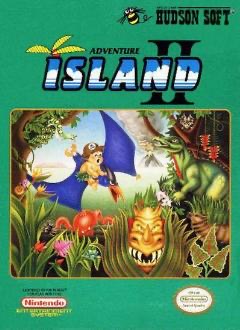
Tina has been kidnapped again, this time by the Evil Witch Doctor's followers, and Master Higgins sets off across eight islands to get her back. The rules are the first game's: keep moving, keep eating, and expect to die a lot. What changes is what you carry in.
Before a stage you pick what comes with you: a dinosaur you've rescued, and one of the stone hammers you've banked. Hammers no longer upgrade to fireballs. A second one just goes in the bag for later. The dinosaurs are the real hook. A blue camptosaurus whacks with its tail and walks on ice without sliding. A red one breathes fire and swims over lava, but only for a while. A pteranodon flies you over trouble and drops stones. The elasmosaurus is the only one that survives underwater, and it swims faster than you do.
Where it sits in history
Now Production developed it and Hudson Soft published it on the NES in 1991. The first Adventure Island was a port of Sega's Wonder Boy with a new hero swapped in. This one is an original, as were most of the later games in the series. A portable version followed on the Game Boy in 1992, called Takahashi Meijin no Bouken Jima II in Japan and just Adventure Island outside it.
Allgame's Skyler Miller rated it above the original and singled out the improved graphics, the map screen and the four dinosaur buddies, each with their own ability. The game also turns up in the manga Cyber Boy, which ran from 1991 to 1993.
How it plays today
Kinder than the first, in a sneaky way. The stages are much shorter, which is just as well: the checkpoints are gone, and dying means starting that stage over. Short and unforgiving is a good deal. You lose a minute, not a quarter hour.
Hidden eggs make a different noise when you strike near them, and a key inside one opens a bonus zone, an item room or a shortcut to the next island. That is a lovely bit of design: the game tells you something is there and leaves you to decide if it's worth the detour. Boss fights have a mean streak too. Lose to one and he moves to another stage, so you clear two to face him again.
Compared with
Why it matters
Choosing who comes with you is a small, honest decision about trust. Take the elasmosaurus into a water level and you survive. Take the red camptosaurus and you lose it. Nobody is better than the others, only better for the day. It is a nice way to see that you don't have to be everything yourself.
Csikszentmihalyi describes flow as the absorption you get when challenge matches skill, with clear goals and quick feedback. Short stages and a sound that tells you where the eggs are give you that tight loop. Failure is instant and the fix is right there.
Read: The zone: why good games make time disappear →
- Csikszentmihalyi, M. (1990). Flow: The Psychology of Optimal Experience.
What you're levelling up
You have been training these without noticing. Here is how to do it on purpose, and where it pays off away from the couch. All the skills games teach →
Planning ahead
In the game. You choose a dinosaur and a hammer before each stage. The elasmosaurus is the only one that lives underwater, so the wrong pick loses you your ride.
Do it on purpose. Before you start an island, say out loud which dinosaur you'll take and why. Check after.
Off the couch. Pack for the weather, not the forecast. Sort the booking before you need it. Turning up prepared is the cheapest way to look good.
Teamwork
In the game. Four dinosaurs, each with a skill the others lack: ice-walking, fire, flight, swimming. The game is picking the right mate for the job.
Do it on purpose. Beat one island using a different dinosaur each stage. Note which fits where.
Off the couch. At work and on a date, you're not meant to be the whole show. Know what your mates are good at, then let them be good at it.
Curiosity
In the game. Strike near a hidden egg and it makes a different noise. Open it and a key gets you into a bonus zone, an item room or a shortcut to the next island.
Do it on purpose. Play one stage hitting the ground at every odd spot, listening for the sound. Count what you find.
Off the couch. Ask the second question. The person who wonders what's behind the small talk finds out the good stuff, and people notice.
Verdict · 8/10
A tidier, friendlier sequel with the best idea in the series: pick your mate before you go in. Short stages and a sharp little inventory make it easy to say one more go.