What it was
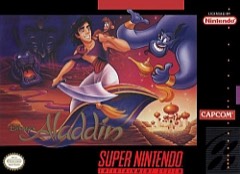
Capcom made this one for the Super Nintendo in 1993, off the back of Disney's 1992 film. Shinji Mikami designed it. You run through the streets of Agrabah as Aladdin, stomping on guards or stunning them with thrown apples, collecting gems, and dodging whatever the stage throws at you. Health is a row of hearts, starting at three, and pickups and bonus stages can add more.
Hunt out the scarab in a treasure chest and you get a bonus wheel where Genie hands out extra lives and goodies. Two stages break up the running: the Cave of Wonders escape, where you ride the carpet up and down ahead of rising lava, and a free-flying carpet ride with Jasmine between stages five and six that ends when 'A Whole New World' does.
Where it sits in history
It came out in November 1993, the same month Virgin Games put out a different Aladdin on the Sega Genesis. In that one Aladdin swings a scimitar; in Capcom's he doesn't. Mikami later said that if he hadn't made the SNES game, he'd probably have bought the Genesis one, because of the sword and the better animation. Fair play to the bloke.
It sold roughly 1.75 million copies worldwide, which made it Capcom's biggest SNES seller after Street Fighter II and its variants, and the best-selling licensed game on the system. In the UK it was the top-selling SNES game of December 1993. Capcom also ported it to Game Boy Advance in 2003 and 2004, and that port got mixed reviews: GameSpy called it the most disappointing of all the SNES-to-GBA ports.
How it plays today
The reviews at the time loved the graphics, animation and controls. Nintendo Power's only grumble was that it wasn't as hard as you'd expect from Capcom, and that's still the honest read. It's a game you finish, not a game that finishes you.
That makes it a good one to hand to someone who says they don't play games. Run, jump, chuck an apple. It teaches itself in about a minute.
Compared with
- The Lion King: Also based on a Disney film, and a lot meaner about it.
- The Jungle Book: Another Disney platformer from the same stretch of the 16-bit era.
- Aladdin: A different Aladdin again, on a different console.
Why it matters
Csikszentmihalyi's research on flow says absorption comes when challenge matches skill. Aladdin sits on the gentle side of that match: a game where almost nobody gets stuck, so almost everybody gets to the carpet ride.
That's worth something. Not every game has to hurt to be worth your time, and a smooth run of apples and rooftops is a fine way to feel your own skill working. Plenty of us learned we were good at something because a game let us win.
Read: The zone: why good games make time disappear →
- Csikszentmihalyi, M. (1990). Flow: The Psychology of Optimal Experience.
What you're levelling up
You have been training these without noticing. Here is how to do it on purpose, and where it pays off away from the couch. All the skills games teach →
Hand-eye coordination
In the game. Apples have to hit moving guards while you keep running and jumping, and the Cave of Wonders carpet escape has you steering up and down through obstacles.
Do it on purpose. Next session, take out every enemy with apples only. No jump-stomps. See how many you miss.
Off the couch. Catching a set of keys someone chucks at you, parking in a tight spot, hitting a cricket ball. It all runs on the same wiring.
Timing and rhythm
In the game. The carpet ride with Jasmine runs until 'A Whole New World' ends, so you've got a fixed window to grab as many gems as you can.
Do it on purpose. Replay the Jasmine bonus and try to grab more gems than last time without crashing into anything.
Off the couch. Knowing when to speak in a meeting, or when to leave a party. Good timing beats good intentions.
Keeping your cool
In the game. The Cave of Wonders has lava closing in behind you while you dodge obstacles. Panic gets you cooked.
Do it on purpose. Do the escape without once mashing buttons. Slow your breath and play the next three seconds only.
Off the couch. A deadline closing in, a tough chat with the boss, a first date where you've gone blank. Calm hands, calm voice.
Verdict · 8/10
Gorgeous, gentle and a bit too easy, which is fine. One of the best licensed games the SNES got.