What it was
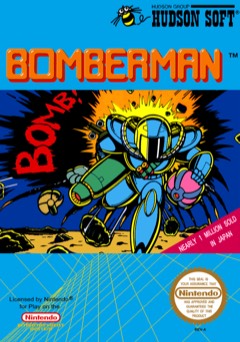
You are a bomb-making robot trying to escape an underground complex. Reach the surface and you become human. Each of the 50 levels is a maze seen from above, full of enemies and breakable blocks. Drop a bomb, step away, and it bursts into jets of fire in four directions, clearing blocks and anything standing in them. Defeat every enemy, find the exit hidden under a block, and move on to the next.
Power-ups hide in the blocks. Some last forever, like a bigger blast or more bombs at once. Others, like walking through walls or a remote detonator, last only until you die. Let the timer run out, or blow up the exit, and more enemies pour in. A password lets you pick up where you left off.
Where it sits in history
Hudson Soft developed and published it. It is an expanded remake of a 1983 computer game, Bakudan Otoko, and both were made by Hudson's Shinichi Nakamoto. He added the power-up system, inspired by space shooters, and swapped the original hero, an old man in a hat, for the robot from Hudson's Famicom Lode Runner. His reason: he would not feel so bad watching a robot get blown up. The ending turns Bomberman into the Lode Runner hero, which makes this a prequel.
It was Hudson's first game with sampled sound, used for the explosion; Nakamoto listened through many recordings to find the most satisfying one. Jun Chikuma wrote the music. It came out in Japan on 20 December 1985 and in North America in January 1989, when the box claimed nearly a million copies sold in Japan. Reviews then were mixed. Nakamoto later called the Famicom version the one and only version of his game.
It returned on the Game Boy Advance in 2004 in the Classic NES Series and in the 2026 Super Bomberman Collection.
How it plays today
The bomb still feels great: that short fuse, the step back, the satisfying boom. Clearing a crowded screen with one well-placed blast is as good as it ever was.
It is also plain. Fifty levels of similar mazes and no multiplayer, the thing later Bomberman games became famous for, make it more of a solo puzzle to dip into than a party game. Play a few levels at a time and it stays fun.
Compared with
- Bomberman II: The 1991 NES sequel, which added the multiplayer this one lacks: up to three friends in Battle Mode.
- Super Bomberman: Where the series became the four-player party game people know.
- Lode Runner: Hudson's earlier Famicom port, whose hero Bomberman turns into at the end.
Why it matters
Nakamoto chose a robot hero so he would not feel sorry each time it blew up. Then he gave that robot a dream: get to the surface and become a person. James Paul Gee describes how players take on a projective identity, part themselves and part the character, shaped by what they want that character to become.
Fifty levels down, players are not just clearing mazes. They are trying to get a small machine home, and to make it human. We care about the things we help.
Read: Who you are when you play →
- Gee, J. P. (2003). What Video Games Have to Teach Us About Learning and Literacy.
What you're levelling up
You have been training these without noticing. Here is how to do it on purpose, and where it pays off away from the couch. All the skills games teach →
Planning ahead
In the game. Drop a bomb, step away, boom in four directions. Clearing a crowded screen with one well-placed blast is the whole joy.
Do it on purpose. Play a level where you try to clear it with the fewest bombs. Count them and beat it next time.
Off the couch. Doing more with less is a money skill and a work skill. One good move beats five rushed ones.
Judging risk
In the game. Run the timer out or blow up the exit and more enemies pour in. Some power-ups, like the remote detonator, are gone the moment you die.
Do it on purpose. Next time you've got a temporary power-up, play extra safe and see how long you keep it. Compare with playing loose.
Off the couch. Some things you can't get back once they're gone: trust, a deposit, a good first impression. Protect them more carefully than the rest.
Deep focus
In the game. Fifty levels of similar mazes, solo. It's a puzzle to dip into, and once you're in it, it's hard to look away.
Do it on purpose. Phone away, five levels in a row. Notice when you hit the zone and what got you there.
Off the couch. Study, gym, a hobby you want to get good at. Learning to drop into one thing on purpose is what separates people who improve from people who just turn up.
Verdict · 6/10
Simple, solitary and the start of everything Bomberman became. The bomb was right from day one.