What it was
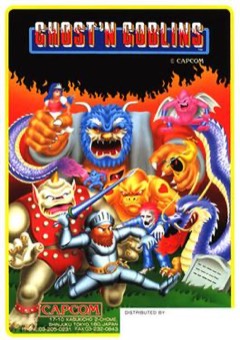
Sir Arthur starts in full armour. One hit and it falls off, leaving him in his underwear. A second hit and he is a pile of bones, sent back to the start of the stage or the last checkpoint. That is the whole deal in Ghosts 'n Goblins, and it explains the game's reputation better than any list of enemies could.
Arthur is trying to rescue Princess Prin-Prin from Astaroth, king of the Demon World, through graveyards, forests, caves and towers full of zombies, ogres, dragons and the flying red demons that shadow him. He throws lances by default and can swap to daggers, torches, axes or a shield, picked up from fallen enemies. Some pickups are worse than what you hold, and grabbing one by accident can ruin a run. Every stage has a time limit. Beat Astaroth and the game sends you back to the beginning to play it all again on a harder setting before the true ending.
Where it sits in history
Capcom released Ghosts 'n Goblins, called Makaimura in Japan, in arcades in 1985, and it was among the top-grossing arcade games of 1986 in both Japan and the United States. Micronics programmed the home version, which reached the Famicom on 13 June 1986 as the first Famicom game on a 128 KB cartridge. North America got the NES version in November 1986 and Europe in March 1989. Original composer Ayako Mori scored it.
The NES version sold 1.64 million copies worldwide. With Commando, it is credited with making Capcom's name in the 8-bit era, and it began a series that runs through Ghouls 'n Ghosts, Super Ghouls 'n Ghosts and the Gargoyle's Quest spin-offs.
How it plays today
The difficulty is the whole conversation. Arthur's jump is fixed once you leave the ground, enemies appear from every direction, and the red demons in particular dodge and dive in ways that feel unfair until you learn them. It is a game you memorise rather than react to, and each small step forward feels like a real win.
The NES port is rougher than the arcade game. Sprites flicker heavily when the screen fills, some animation is choppy, and hit detection can feel generous to the enemy. The forced second loop will test anyone's patience. Played with save states on a re-release, it becomes a satisfying puzzle; played straight on a cartridge, it is a trial few finish.
Compared with
- Super Ghouls 'n Ghosts: The SNES sequel keeps the two-hit armour and the double loop, but looks far better and controls a little more kindly.
- Castlevania: The NES's other gothic action game also locks your jump, but is more generous with health and less random.
- Mega Man 2: A later Capcom game that shows how the company learned to make hard games feel fair.
Why it matters
Two hits. The first knocks Arthur's armour off, the second leaves a pile of bones, and back you go. Beat Astaroth and Ghosts 'n Goblins sends you to the start to do it all again. If any game was built around the myth of Sisyphus, it's this one.
Albert Camus ended his essay on Sisyphus, rolling the same boulder up the same hill forever, with "One must imagine Sisyphus happy." Camus found meaning in the struggle itself, not the summit. Jesper Juul describes the paradox of failure: we avoid failing in life yet seek it in games, where failure makes us reconsider and improve. Arthur running through a graveyard in his underwear is that paradox in one picture, ridiculous and determined at once. You memorise the red demons' dives, lose, learn, lose again. The NES version sold 1.64 million copies, and every one came with that hill. It says something good about us. We can laugh at our own failures, then walk straight back up.
Read: One must imagine Mario happy →
- Camus, A. (1942). The Myth of Sisyphus.
- Juul, J. (2013). The Art of Failure: An Essay on the Pain of Playing Video Games. MIT Press.
What you're levelling up
You have been training these without noticing. Here is how to do it on purpose, and where it pays off away from the couch. All the skills games teach →
Bouncing back
In the game. One hit and Arthur's armour falls off; a second and he's a pile of bones, back to the checkpoint. Beat Astaroth and it sends you back to do the lot again.
Do it on purpose. Count your deaths on one stage tonight. Next session, beat that count, and after each death say one thing you'll do differently.
Off the couch. Arthur keeps going in his undies. Laughing at yourself after a stuff-up and having another crack is far more attractive than pretending it never happened.
Pattern recognition
In the game. The flying red demons dodge and dive in ways that feel unfair until you learn them. Then they're just a pattern.
Do it on purpose. Next time a red demon shows up, don't attack. Watch three dives, say the pattern out loud, then punish the fourth.
Off the couch. The mate who always bails, the boss who always panics on a Thursday. Learn the dive and it stops catching you out.
Memory and routing
In the game. Arthur's jump is fixed once he leaves the ground and enemies come from every side. It's a game you memorise rather than react to.
Do it on purpose. Break the first stage into three chunks and master each before you go further. Write the route down from memory afterwards.
Off the couch. A speech, your lines in a play, a new job's procedures. Chunk it and drill it like a stage.
Verdict · 6/10
A landmark of punishing design with a great look and theme, let down on the NES by flicker and a double loop. Best enjoyed with a re-release and a lot of patience.