What it was
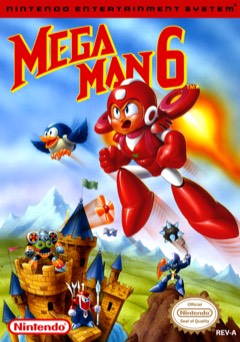
A robot tournament is about to start. Its host, the mysterious Mr. X, announces that he has reprogrammed the eight finalists to conquer the world, and Mega Man, there as an observer, goes after them. The finalists come from everywhere: Yamato Man, Knight Man, Tomahawk Man, Centaur Man and the rest. Behind Mr. X's disguise is exactly the man you suspect.
The bones are familiar. Eight stages in any order, eight weapons, a weakness chain to solve. The new parts are the Rush Adaptors. Jet Mega Man fuses you with your dog to fly or hover, at the cost of the charge shot; Power Mega Man trades range for a heavy punch that smashes big blocks. Four stages split into two routes, and you need an adaptor to open the second path. Only one route in each holds a letter for Beat, the robot bird, so the stages reward a second look. A quiet improvement called the Energy Balancer tops up whichever weapon is lowest when you grab ammo.
Where it sits in history
Capcom released Mega Man 6 in Japan in 1993, alongside work on Mega Man X for the Super Nintendo. With the NES fading, Capcom chose not to publish it abroad, so Nintendo of America released it in March 1994, around the time it launched the cheaper top-loading NES. It was the last Mega Man on the console, and the last in 8-bit style until Mega Man 9 in 2008. Europe did not get it at all until the Nintendo 3DS Virtual Console in 2013.
The bosses came from fans in Japan and, for the first time, North America. Of more than 200,000 entries worldwide, eight made the game: six from Japan, and Knight Man and Wind Man from readers of Nintendo Power, whose robots appear on the North American box. Keiji Inafune found the Rush Adaptors hard to draw and never quite believed in them; his theme for the designs was the world as a stage. Yuko Takehara wrote the music. Nintendo Power named it the best NES game of 1993.
How it plays today
This is the most generous of the NES games. The adaptors change how you move through a level rather than just how you shoot, and the split routes make the stages feel bigger than their screens. The introductions for each Robot Master give the cast some character. It does not have Mega Man 2's tunes or Mega Man 3's swagger, but it is smooth and it is kind to you.
The silliness is real. Mr. X's reveal is a joke the series had already told, and some reviewers in 1994 were plainly tired of the formula. Played now, as one of six rather than the sixth in six years, the tiredness fades and what is left is a well-made late NES game from people who knew the hardware inside out.
Compared with
- Mega Man 5: The easier, plainer game before it; same Beat letters, fewer routes.
- Mega Man 7: The series' move to the Super NES, with bigger sprites and a slower feel.
- Mega Man X: Developed at the same time, it shows the faster future the NES games were making way for.
Why it matters
One critic said Mega Man 6 was retro before retro was cool: an 8-bit game made with care when everyone else had moved to 16. That is why it lands so softly today. Nostalgia research by Wildschut and colleagues finds the feeling is mostly positive, often involves the people close to us, and leaves us feeling more connected and better about ourselves.
A game like this is built for that. Its look and rules are the ones a generation grew up with, and playing it is less about novelty than about going back to a room you knew, with someone you knew, and finding the furniture where you left it.
Read: Why old games feel like home →
- Wildschut, T., Sedikides, C., Arndt, J., & Routledge, C. (2006). Nostalgia: Content, triggers, functions. Journal of Personality and Social Psychology, 91(5), 975-993. doi:10.1037/0022-3514.91.5.975
What you're levelling up
You have been training these without noticing. Here is how to do it on purpose, and where it pays off away from the couch. All the skills games teach →
Judging risk
In the game. Jet Mega Man flies but drops the charge shot; Power Mega Man punches through blocks but loses range. Every adaptor is a trade.
Do it on purpose. Pick one stage and play it twice, once with each adaptor. Note which sections each one makes safer and which it makes worse.
Off the couch. Every choice costs something. A job that pays more but eats weekends. Name the trade before you take it.
Curiosity
In the game. Four stages split into two routes, and only one in each holds a Beat letter. The stages reward a second look.
Do it on purpose. Go back to a split stage and take the path you skipped. See what's down there.
Off the couch. Taking the other road now and then, a new pub, a new mate's group, is how life stays interesting. The people you date will find you more interesting too.
Systems thinking
In the game. The Energy Balancer tops up whichever weapon is lowest when you grab ammo. Understanding that changes which weapons you spend freely.
Do it on purpose. For one stage, deliberately use your least-loved weapon and watch how the balancer feeds it.
Off the couch. Knowing how the system works, like where your pay actually goes each month, lets you play it on purpose.
Verdict · 8/10
The NES Mega Man formula at its most polished, with two new ways to move and stages that branch. A fine goodbye to the console.