What it was
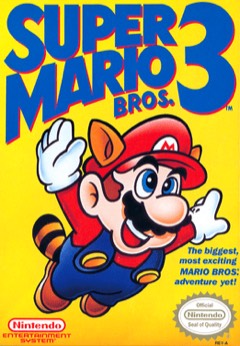
Super Mario Bros. 3 is a side-scrolling platformer in eight themed worlds: grassland, desert, sea, a land of giants, the sky, ice, pipes and Bowser's dark country. For the first time in the series you move across an overworld map between stages, with bonus houses, roaming Hammer Brothers and airships waiting at the end of each world.
The headline is the suits. The Super Leaf gives Mario a raccoon tail to fly with; the Frog Suit makes water levels easy and dry land awkward; the Tanooki Suit turns him into a statue; the Hammer Suit throws hammers. Each one changes how a stage plays, and stages are built to show that off.
Where it sits in history
Nintendo released it in Japan in October 1988, in North America in February 1990 and in Europe in 1991. By the time it reached the West the NES was five years old and the Super Famicom was about to launch in Japan, and it still looked like the machine had a lot left.
In the United States it was trailed by The Wizard, a 1989 film that ends at a video game tournament where the final round is the first public look at the game. That made it one of the most anticipated cartridges of its era, and it went on to become one of the best-selling games ever released on the console.
How it plays today
Very well. The controls are tight, the jumps are readable, and the level design teaches through play rather than text. Most stages last a couple of minutes, which suits short sessions, and the map lets you skip ahead with warp whistles if you know where they are.
The parts that show their age are small: no battery save on the original cartridge, so a full run is one sitting or a warp-whistle shortcut, and a handful of late stages lean on memorisation. Play a re-release with save states and those go away.
Compared with
- Super Mario Bros.: The original is the blueprint; this is the finished building, with a map, suits and far more variety per world.
- Super Mario World: The SNES follow-up is bigger and gentler, with Yoshi and a cape that flies further. SMB3 is tighter and harder.
- Super Mario Bros. 2: The Western sequel plays like a different game because it was one. SMB3 is the return to what the series became.
Why it matters
Watch someone play Super Mario Bros. 3 well and their face goes still. The jumps are readable, stages last a couple of minutes, and a new suit changes the rules just often enough to keep you reaching. Mihaly Csikszentmihalyi called this flow: absorption when challenge matches skill, with clear goals and immediate feedback. Self-consciousness drops away and time distorts. Super Mario Bros. 3 may be the best 8-bit teacher of it, because it teaches through play rather than text.
Plenty of Western players first met that state in front of this cartridge in 1990, some having glimpsed it at the end of The Wizard. No battery save meant a full run happened in one sitting, and whole afternoons went with it. Here flow was not a rare peak. It was ordinary, domestic and shared: one person flying a raccoon tail over a level while someone on the couch said go left, no, left.
Read: The zone: why good games make time disappear →
- Csikszentmihalyi, M. (1990). Flow: The Psychology of Optimal Experience.
What you're levelling up
You have been training these without noticing. Here is how to do it on purpose, and where it pays off away from the couch. All the skills games teach →
Problem solving
In the game. The Frog Suit makes water easy and dry land awkward, the Tanooki Suit turns you to stone. Every stage is built to test which suit fits.
Do it on purpose. Before each stage, decide which suit you'll use and why. Afterwards, ask if another would have been better.
Off the couch. Picking the right approach for the situation, formal or chill, short email or phone call, is half of getting things done.
Planning ahead
In the game. The overworld map has bonus houses, roaming Hammer Brothers and airships, and warp whistles if you know where they are. You choose the route.
Do it on purpose. Plan which items you'll save for each airship before entering a world. Stick to it.
Off the couch. Saving your best for when it counts, whether it's money, energy or a good joke, beats blowing it early.
Curiosity
In the game. Warp whistles and hidden secrets reward the player who flies up where nobody's looking with the Super Leaf.
Do it on purpose. In every grassland stage, fly to the top of the screen once and see what's there.
Off the couch. Being curious about people, really asking about their weird hobby or their home town, is half of what makes a date go well.
Verdict · 10/10
The high point of 8-bit platforming and the template for most Mario games since. If you only play one NES game, play this.