What it was
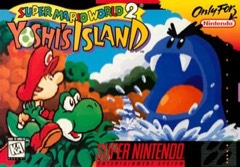
A stork is flying two baby brothers to their parents when Kamek, Bowser's wizard, snatches one. The other, baby Mario, lands on Yoshi's back, and a relay of Yoshis carries him across six worlds and 48 levels to get his brother Luigi back. Get hit and Mario floats away in a bubble, wailing, while a countdown ticks; catch him before it runs out or the Koopas carry him off.
Yoshi is not Mario with a saddle. He swallows enemies with his tongue and turns them into eggs, up to six trailing behind him, then aims and throws them, bouncing them off walls to reach targets you cannot touch. He flutters in the air to stretch a jump, ground-pounds through soft earth, and turns into a car, a helicopter, a drill or a submarine in special sections. Each level hides red coins and flowers, and collecting everything opens bonus stages.
Where it sits in history
Shigeru Miyamoto asked Yoshi's designer Shigefumi Hino for something new, and Hino, feeling the 2D Mario formula had been mined out, pitched Yoshi in the lead with a gentler pace: no time limit, more to explore, a flutter jump that forgives. Nintendo EAD worked on it from early 1992 to mid-1995. Artist Hisashi Nogami drew the look by hand and it was scanned in; Koji Kondo wrote the music.
Midway through, Donkey Kong Country arrived with its rendered 3D-look sprites, and Nintendo's marketing thought Yoshi's Island looked flat beside it. The team doubled down on the hand-drawn style instead, and used the new Super FX2 chip for rotating, stretching and warping effects. It came out in Japan in August 1995, two months later elsewhere, and sold over four million copies. It was the last 2D Mario-series platformer for more than a decade.
How it plays today
Beautifully. The crayon-and-marker art still looks like nothing else on the console, and the special effects are woven into the levels rather than tacked on. The egg-aiming takes an hour to master and then becomes second nature, and the level design keeps finding new uses for it. The bosses are big, silly and inventive, and Kondo's soundtrack is warm and catchy.
Two complaints. Baby Mario's crying is shrill, and you will hear a lot of it. And the pace is slower and more deliberate than a Mario game: if you want to run and jump, all the hunting for red coins and flowers can feel like a chore. Chasing a perfect score in every level is a serious undertaking. Play for the journey first; go back for completion if it hooks you.
Compared with
- Super Mario World: The game it calls a sequel; Yoshi debuted there as Mario's mount and here takes the lead with a whole new moveset.
- Donkey Kong Country: The rival it answered: rendered, glossy and quicker, where Yoshi's Island is hand-drawn and more inventive.
- Kirby Super Star: Another late SNES platformer built around swallowing enemies, looser and more chaotic where Yoshi is careful and puzzly.
Why it matters
Yoshi's Island looks like a child drew it, and keeping that look took a fight. Nintendo's marketing thought the hand-drawn art looked flat beside Donkey Kong Country, and the team doubled down on crayon and marker anyway. A game about carrying a baby, drawn in the medium of the very young. That is more than a style. It is a reminder of where play starts.
Donald Winnicott, the paediatrician and psychoanalyst, saw play as the space between inner and outer worlds, where people are creative and find a self. All of us passed through that space long before we could hold a controller: scribbling, stacking, making up rules as we went. Yoshi's Island hands it back. There is no timer, the flutter jump forgives, and a hit costs you a scramble, not the baby, if you are quick. The crying is shrill, yes. But the game asks you to look after someone small, in a world that looks drawn by someone small.
Read: Older than us: play before people →
- Winnicott, D. W. (1971). Playing and Reality.
What you're levelling up
You have been training these without noticing. Here is how to do it on purpose, and where it pays off away from the couch. All the skills games teach →
Spatial thinking
In the game. Yoshi's eggs bounce off walls, so half the targets get reached by angles, not straight shots. You're doing geometry with a dinosaur.
Do it on purpose. Find the target you keep missing and stop throwing on hope. Trace the bounce with your finger before each throw, then check where it went.
Off the couch. Picturing angles helps with pool at the pub, reversing into a tight park and packing a ute for a move. Mates always want the one who can make it fit.
Keeping your cool
In the game. Get hit and baby Mario floats off in a bubble, wailing, while a countdown ticks. The shrill crying is the perfect setup for a second mistake.
Do it on purpose. When the bubble goes up, take one breath before you chase it. Notice how often you grab him first go when you breathe versus when you lunge.
Off the couch. A crying kid, a boss yelling, a mate panicking: noise makes people flap. Staying steady when it's loud is what makes people trust you, and that includes a date when the night goes sideways.
Curiosity
In the game. Every level hides red coins and flowers, and collecting the lot opens bonus stages. The ones you miss are usually behind something you didn't poke.
Do it on purpose. Replay one finished level with a single goal: every red coin. Before you even think about a guide, list the spots you haven't checked.
Off the couch. One more question, one more corner, is how you find the good job, the good flat and the interesting person at the party.
Verdict · 10/10
One of the best-looking and most inventive platformers on any 16-bit console. The crying grates, but little else does.