What it was
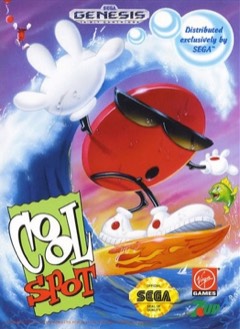
Spot is the mascot for the soft drink 7 Up, and this is his own game. You throw soda bubbles at enemies in any direction, and you can cling to things and climb by jumping up in front of them. Each level has other cool spots locked in cages, and they look exactly like you. To free them, you need to collect a set number of spots lying around, and the number usually goes up as you go.
Your health is a Spot face that slowly bends forward and finally falls over as you take hits. There's a time limit on every level, no save feature, and flagpoles for checkpoints. If you grab enough spots to reach the bonus stage, you can find a hidden letter. The letters spell UNCOLA, which was 7 Up's slogan. Collect one and you get a continue that puts you back on the level you died on, though your score resets.
Where it sits in history
Virgin Games developed Cool Spot in 1993, and it came out on a pile of platforms: Genesis, SNES, Master System, Game Gear, Game Boy, Amiga and MS-DOS. In North America, the SNES version came out in September 1993. Japan got it on 10 December 1993 and the PAL regions on 24 February 1994. Virgin Interactive Entertainment published it everywhere.
It showed up when other brand mascots were getting their own games too, like Chester Cheetah and the Noid. It sold a million copies, and a sequel, Spot Goes to Hollywood, followed in 1995.
Critics liked it. Total! ranked the SNES version 65th on its 1995 Top 100 SNES Games and called it "not deep, but a great laugh". Super Play ranked it 100th the next year and praised the graphics, calling it one of the few non-Mario platformers worth more than a passing glance. Complex, in 2018, ranked it 88th and called it pretty enjoyable despite the product placement.
How it plays today
It's a game that sells you a fizzy drink and gets away with it, mostly because it's fun to move around in. The animation is the thing everyone remembers, and the cheeky health meter is a small joke that keeps paying off.
It isn't deep, and Total! said as much. But a short, bright platformer that lets you shoot bubbles in any direction is easy to pick up and hard to put down. Just don't expect to save your progress.
Compared with
- Aladdin: Another SNES platformer that people remember for how good it looks.
- Earthworm Jim: A cheeky mascot-style platformer with a lot of personality.
- Super Mario World: The benchmark Super Play held non-Mario platformers up against.
Why it matters
Cool Spot is a game that exists because a soft drink wanted a hero. That should make it hollow, and yet people still remember it fondly. It's a reminder that how a game feels in your hands can outweigh what it was made to sell.
Jesper Juul points out that we avoid failing in life yet go looking for it in games, because each failure sends us back in a bit wiser. Cool Spot makes failing funny: the little face on your health meter bends and finally topples as you take hits. Failing in a game that doesn't take itself seriously is a small, safe way to practise getting back up.
Read: Why old games feel like home →
- Juul, J. (2013). The Art of Failure: An Essay on the Pain of Playing Video Games. MIT Press.
What you're levelling up
You have been training these without noticing. Here is how to do it on purpose, and where it pays off away from the couch. All the skills games teach →
Hand-eye coordination
In the game. You throw soda bubbles in any direction while jumping, and climbing means jumping up in front of the thing you want to cling to.
Do it on purpose. Take one level and only attack at angles you'd normally skip. Keep going until it feels natural.
Off the couch. Anything where your hands have to follow your eyes: catching a ball, cooking, driving a manual.
Keeping your cool
In the game. Every level has a time limit, and taking damage bends your health face a little further each hit.
Do it on purpose. Play a level while the clock is under thirty seconds. Breathe, don't rush your jumps.
Off the couch. Deadlines, queues, an awkward silence on a first date. Stay loose and the clock matters less.
Pattern recognition
In the game. The number of spots you need to open the cage climbs as the game goes, so you learn each level's shape to know where the rest are hiding.
Do it on purpose. Look for what's different in each level before you move. Where do the spots cluster?
Off the couch. Spotting a trend in your sales, a tell in a mate's story, a gap in the traffic.
Verdict · 7/10
A bright, funny, shallow-in-a-good-way platformer with a famous bit of animation. A great laugh, as Total! put it.