What it was
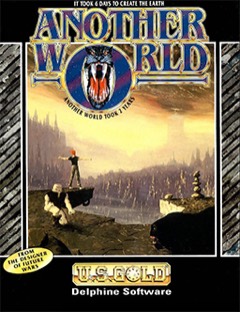
A physicist called Lester is working late in his lab in a thunderstorm when lightning hits his particle accelerator and throws him onto a hostile alien planet. He's soon in a prison camp, escaping with an alien mate called Buddy. That's the plot, and the game never says a word about it. There's no on-screen text, the aliens speak a made-up language, and the only HUD is an oxygen bar when you swim.
Lester can't take a hit. A projectile, an animal or a hazard ends the run. Checkpoints are generous, so you die, learn the room and go again. Later you pick up a laser pistol with three modes: a normal shot, a force field and a charged blast that breaks through shields and some walls. The enemies get the same tricks.
Where it sits in history
Éric Chahi made it nearly alone, over about two years, for the Amiga and Atari ST. He wrote his own engine and drew everything as vector polygons to save memory, using rotoscoping, filming himself, to plan the movements. Delphine published it in November 1991. In North America it was sold as Out of This World.
Interplay brought it to the Super NES in 1992. Rebecca Heineman programmed it. She has said Interplay wouldn't pay for a Super FX chip, or for the extra RAM she wanted next, so in the end she ran her code out of the console's DMA registers and got a good frame rate from pure software polygons. The SNES version opens with a prologue taken from Lester's diary and has a dynamic score during play, unlike the Amiga. Interplay also wanted to swap Chahi's intro music, and he fought it, even faxing them a looped sheet of paper reading keep the original intro music, until Delphine's lawyer settled it.
How it plays today
It's short, hard and unlike nearly anything else on the console. It leaves you alone to work things out, and when you do, it feels like you earned it.
Expect to die a lot. The deaths are quick and fair, and each one teaches you something. It's a mood piece more than a platformer, and it works.
Compared with
- Flashback: Delphine's later game, which Complex called Another World's spiritual successor.
Why it matters
Juul says we avoid failure in life yet go looking for it in games, and that failing makes us reconsider and get better. Another World leans on that. One hit kills, so you fail constantly, and the only way forward is to stop and think about what just happened.
It also shows how much a game can say without words. You and Buddy end up trusting each other with no dialogue at all. Sometimes the people closest to us are the ones we've never needed to explain ourselves to.
Read: Wanting, not liking: what dopamine really does when you play →
- Juul, J. (2013). The Art of Failure: An Essay on the Pain of Playing Video Games. MIT Press.
What you're levelling up
You have been training these without noticing. Here is how to do it on purpose, and where it pays off away from the couch. All the skills games teach →
Pattern recognition
In the game. Each room hides a threat you can only read by dying once, and the lasers and animals repeat their rhythm.
Do it on purpose. Before you move in a new room, say out loud what you think kills you.
Off the couch. Clocking in your first week at a new job which meeting always runs over and who always cops the blame, before it lands on you.
Problem solving
In the game. With no clues or text you work out which of the laser's three modes beats each situation.
Do it on purpose. Stuck? Try each of the gun's three modes before you look anything up.
Off the couch. A flat-pack wardrobe with the instructions missing: try each part every way before you ring for help.
Bouncing back
In the game. One hit ends Lester, and you restart at the last checkpoint again and again.
Do it on purpose. After every death, name what killed you before you hit continue.
Off the couch. A bad date: name the one thing you'd do differently, then book the next one.
Verdict · 9/10
A short, moody game that trusts you to work it out. Worth an evening even if it beats you up.