What it was
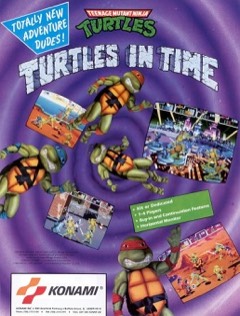
The Turtles are watching April O'Neil report from Liberty Island when Super Krang flies off with the Statue of Liberty and Shredder cuts into the broadcast to laugh at them. They chase the Foot through New York, the sewers and the Technodrome, and Shredder throws them into a time warp. To get home they fight through the past and the future, from a prehistoric land to a pirate ship and beyond.
Pick any of the four Turtles, each with his own speed and strength. Hit an enemy several times in a row for a power attack, or slam a Foot soldier into the ones around him. A jump, a dash and a slide fill out the moves. Two players fight side by side.
Where it sits in history
The arcade game came first, in 1991, a sequel to Konami's first Turtles arcade game and based mostly on the 1987 cartoon; it became Konami's best-selling arcade title. The Super NES version followed in 1992, numbered IV in the west to follow the three NES games, and called Hero Turtles in Europe. Japan kept the plain title.
Konami changed more than it cut. Some animation and voice samples went, and the arcade's Pizza Power song gave way to the cartoon theme. In return the Neon Night-Riders stage became a forward-scrolling ride behind the Turtles, a new Technodrome stage arrived, and new bosses joined: the Rat King, Slash, and Bebop and Rocksteady, with Super Shredder from the second film at the end. It added a time-trial mode and a one-on-one versus mode. It was the top-selling Super NES game in the US in September 1992.
How it plays today
It plays as well as anything in the genre on the console. The Turtles move fast, the hits are clean, and the cartoon look and colour hold up beautifully. Throwing Foot soldiers at the screen is still a pleasure, and the Technodrome fight against Shredder's tank, where you have to throw enemies at the camera to win, is a clever twist on the move.
It is easy, as critics said at the time, even on hard. That is less of a problem with two players, which is how it is meant to be played: an evening's run through history and home again.
Compared with
Why it matters
Turtles in Time is a game about four friends who are never split up. Pick your Turtle, pick your friend's, and you go through every age of history together.
Wildschut and colleagues found that nostalgia is mostly a good feeling, that it usually features people we were close to, and that it leaves us feeling more connected. Ask anyone who played this as a kid and they rarely remember the levels first. They remember who held the other controller, and which Turtle that person always chose.
Read: Why old games feel like home →
- Wildschut, T., Sedikides, C., Arndt, J., & Routledge, C. (2006). Nostalgia: Content, triggers, functions. Journal of Personality and Social Psychology, 91(5), 975-993. doi:10.1037/0022-3514.91.5.975
What you're levelling up
You have been training these without noticing. Here is how to do it on purpose, and where it pays off away from the couch. All the skills games teach →
Problem solving
In the game. The Technodrome fight against Shredder's tank only ends when you throw enemies at the camera. Swinging harder won't do it; thinking differently will.
Do it on purpose. When a boss won't go down, stop and list every move you have. Try the one you haven't used yet.
Off the couch. When the obvious fix keeps failing, at work or in an argument, the answer is usually a move you haven't tried. People who think sideways get called in.
Hand-eye coordination
In the game. Slamming a Foot soldier into the ones around him, or flinging him at the screen, takes clean positioning and quick hands.
Do it on purpose. Play a stage where every kill has to be a throw. Note when you miss and why.
Off the couch. Quick hands help in sport and in the kitchen with three pans going. Cooking someone a decent dinner without a panic is a good look.
Timing and rhythm
In the game. Hit an enemy several times in a row for a power attack, and work in the dash and slide. It flows when you stay on the beat.
Do it on purpose. Pick one string of hits and use it on every enemy for a stage. Notice the moment it starts feeling automatic.
Off the couch. Rhythm makes everything look easy: sport, dancing, a quick comeback at the pub. People with good timing seem relaxed.
Verdict · 9/10
The Turtles at their best: bright, quick, generous, and better with a friend. Not hard, but very hard to put down.