What it was
It's 2191 and aliens have knocked out the Master Computer that runs the colony of New Earth. You're Nova, head of security, and the fix is a fetch quest. Six sectors, each with a data tape, and you can tackle them in any order off a stage select, Mega Man style. In each sector you find an agent who hands over an ID card, use the card to get into the security room, and beat the guard inside to take the tape. Collect all six and you get the control centre, and the alien overlord.
The weapon is a boomerang you can throw in all eight directions. That is a rarity in a 2D NES platformer, and it's the reason the game has its own feel. Power-ups boost the boomerang's strength, range and count, and a helmet-like Power Suit makes Nova fire energy blasts that pass through most surfaces. That suit is where the name comes from. One quirk: fall off the bottom of the screen and you die. In the other two games in the series you drop back to the previous area.
Where it sits in history
Power Blade is a reworked version of a Famicom game called Power Blazer, which Taito put out in Japan on 20 April 1990. For North America the game went through a near-total rebuild: new levels, better controls, the agents to track down, the multi-boomerang power-ups and the suit. The hero changed too, from a cartoonish robot to a muscle-bound action star. The working title was Power Mission, and that's the name it wore at the Summer 1990 Consumer Electronics Show in Chicago, where Nintendo Power called it mega action in the tradition of Mega Man II.
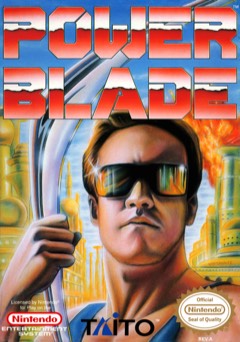
North America got it in March 1991 and Europe in January 1992. Then there's the cover. The title screen and the box art look a lot like promo shots of Arnold Schwarzenegger in The Terminator. Mike Winterbauer, who painted the box, says a certain movie star's lawyers sent him a very unpleasant letter. He showed he'd worked from a photo of himself and the letters stopped. Reviewers were generally warm on it, and IGN put it at number 82 on its 2009 Top 100 NES Games.
How it plays today
It plays tighter than the cover suggests. Aiming a boomerang diagonally to clip a flyer, then ducking back as it returns, makes you think about every screen as a firing problem, not a jumping one. The stage select keeps it fair. Stuck on a sector? Go and do another one.
The agent-hunt in each level is the bit that wears a little thin. You're searching for a person before you can do the fun part. But a password system and level-start continues keep the frustration down, and it's short enough to finish in a night. If you like Mega Man and want something that shoots the other way, this is the one.
Compared with
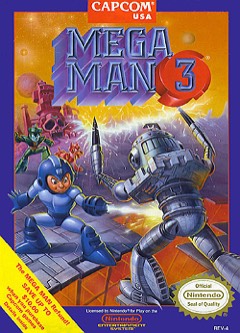
- Mega Man 2: The stage-select template Power Blade borrows from, and the game Nintendo Power compared it to.
- Power Blade 2: The sequel, released in 1992. Fall off the screen and you drop back instead of dying.
- Blaster Master: Another NES action game that makes you earn the fight by finding your way first.
Why it matters
Nova isn't a blank. He's a Terminator-flavoured action hero, and the box leans on that so you'll want to be him. James Paul Gee describes the pull of this kind of character: you're not just you, and you're not just him, you're a blend of the two, shaped by what you bring to it.
That blend is why a boomerang can feel powerful. You aren't steering a sprite. You're the security chief who is going to put the Master Computer right, and the game lets you act like it, one diagonal throw at a time.
Read: Who you are when you play →
- Gee, J. P. (2003). What Video Games Have to Teach Us About Learning and Literacy.
What you're levelling up
You have been training these without noticing. Here is how to do it on purpose, and where it pays off away from the couch. All the skills games teach →
Spatial thinking
In the game. The boomerang goes in eight directions and comes back, so every screen is an angle problem. Where you stand decides which enemies you can hit and which you can't.
Do it on purpose. Play one sector using only diagonal throws. Pick your spot before each enemy shows up.
Off the couch. Parking, packing the boot, rearranging a room. You see the angles before you move anything.
Planning ahead
In the game. Six sectors in any order, each with an agent to find, then a card, then a boss, then the tape. Choose your order and know what each sector needs.
Do it on purpose. Before you start, say out loud which sector you'll do first and why, then see if you were right.
Off the couch. Big jobs at work or a trip with mates go better when you sequence the pieces first.
Keeping your cool
In the game. Fall off the screen and you're gone. Time can run out, too. You have to keep moving without panicking at the edges.
Do it on purpose. Take one level without rushing a single jump. Slow is fine.
Off the couch. A deadline, a tough chat, a first date. Keep the pace steady when you're on the edge.
Verdict · 7/10
A sharp, eight-way action platformer that wears a borrowed face on the box. Short, snappy and better than its cover.