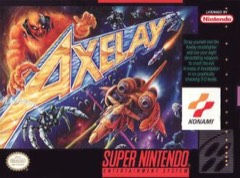
What it was
An alien force called the Armada of Annihilation has taken the planets of the Illis system, and one fighter, the D117B, is sent to win them back. Six stages switch between flying up the screen and across it. In the vertical ones the ground curves away from you like the surface of a drum, a Mode 7 trick that still turns heads.
The clever part is the arsenal. You don't pick up power-ups. Before each stage you choose three weapons, one from each slot: a main gun, a special weapon, a bomb or missile. Every stage cleared adds another option. Take a hit and you don't die; the weapon in use breaks and you limp on with a weak default. A second hit kills you. Crash into something and you die at once.
Where it sits in history
Konami released it in Japan on 11 September 1992, with Super Castlevania IV producer Kazumi Kitaue in charge and Taro Kudo writing the music. Many of the staff later left to found Treasure, makers of Gunstar Heroes. It was meant to stay in Japan, but letters from players and critics changed Konami's mind, and it reached North America later that month.
Reviews were warm and it shows up on lists to this day: 36th in Super Play's top 100 SNES games in 1996, 91st in Electronic Gaming Monthly's 100 best of all time in 1997. Sales were another story. Famitsu counts 4,625 copies sold in Japan. Beat it twice in a row on the hardest setting and a message promises Axelay 2. Low sales meant it never came.
How it plays today
It is a beautiful game and a fair one. The weapon-as-shield rule means a mistake costs you something before it costs you a life, and the loadout screen turns each stage into a small puzzle: which three tools for this one? The horizontal stages, with their huge bosses, look as good as anything on the console.
The vertical stages' curved view takes a moment to read, as Nintendo Power said at the time. Six stages is short, though the game loops harder after the ending.
Compared with
- Life Force: The Konami shooter Axelay borrows its mix of vertical and horizontal stages from.
- Gradius III: Konami's other SNES shooter, built on the power-up bar Axelay does away with.
- Super R-Type: Irem's SNES shooter, slower and much less forgiving.
Why it matters
Jesper Juul calls it the paradox of failure: we avoid failing in life yet seek it out in games, because failing makes us rethink and get better. Most space shooters made one hit fatal. Axelay splits it in two. The first hit is a warning, the second is the lesson.
That half step changes how you play. You know exactly what you did wrong while you still have the chance to do it right. It is a kinder kind of difficulty, and no easier for it.
Read: One must imagine Mario happy →
- Juul, J. (2013). The Art of Failure: An Essay on the Pain of Playing Video Games. MIT Press.
What you're levelling up
You have been training these without noticing. Here is how to do it on purpose, and where it pays off away from the couch. All the skills games teach →
Planning ahead
In the game. Before each stage you pick three weapons, one per slot, and each cleared stage adds an option. The loadout screen turns every stage into a small puzzle.
Do it on purpose. Before each stage, write down why you picked each weapon. After, mark which one actually earned its spot.
Off the couch. Packing for a trip, prepping for an interview, picking what to bring to a date. Thinking about what you'll need before you need it beats winging it.
Keeping your cool
In the game. Take a hit and your current weapon breaks, so you limp on with the weak default. A second hit kills you. Panic after the first hit and you'll take the second.
Do it on purpose. When your weapon breaks, stop shooting for two seconds and reposition. Then carry on.
Off the couch. First mistake in a job interview or a stumble on a date isn't the end. How you handle the next minute is what they remember.
Spatial thinking
In the game. The vertical stages curve the ground away like a drum, a Mode 7 trick that takes a moment to read. You learn to judge distance on a bent screen.
Do it on purpose. Play one vertical stage just tracking where enemies come from the curve. Call them before they flatten out.
Off the couch. Parking, packing the boot, reading a floor plan before you sign a lease. Picturing space well makes you the one others follow.
Verdict · 8/10
A short, gorgeous shooter with one of the best ideas in the genre. Hunt it down.