What it was
A puzzle game in a grid. You are Dana, an apprentice wizard sent to Coolmint Island, an island of ice under attack from the wizard Druidle's flame monsters. Each stage is cleared when every fire is out, and the only way to put one out is ice: slide a block into it or drop one on it.
Dana can walk, climb one block, push ice, and make or break ice blocks beside and below him, much like digging in Lode Runner. Ice placed next to a wall, pipe, jar or other ice freezes to it. Later stages add pipes to travel through and jars that catch fire. There are ten worlds of ten stages, then a code that opens 50 more, and a stage editor for making your own.
Where it sits in history
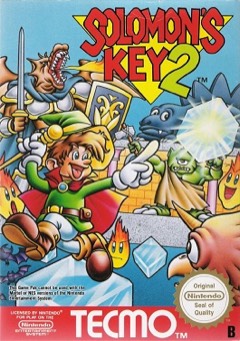
Tecmo released it in Japan in January 1992 and in North America, as Fire 'n Ice, and Europe in March 1993. It is a prequel to Solomon's Key, told as a story an old woman reads to her grandchildren. Japan's cartridge had a save battery and could store your own stages; the English releases use passwords and cannot.
Electronic Gaming Monthly's reviewers split: one found it repetitive, one recommended it only to fans of logic puzzles, one called it the best puzzle game in years, and one, though the graphics looked dated, noted that later stages want 15 to 30 moves planned ahead. Nintendo added it to Nintendo Classics on Switch in February 2021.
How it plays today
Beautifully, if you like thinking. The rules fit in a paragraph, and the stages ask for the same few moves in orders you would never have guessed.
The later worlds keep it fresh. Pipes let Dana slip across the stage, and a jar that touches flame starts to burn, melting any ice you put above it, so a trick that worked for forty stages suddenly doesn't. It came late, March 1993 in the West, and plenty of people missed it. Now it is one of the easiest NES games to recommend.
Compared with
Why it matters
Suits defined playing a game as 'the voluntary attempt to overcome unnecessary obstacles'. Fire 'n Ice is that definition at its plainest: a fire, some ice, and a rule about what freezes to what.
Csikszentmihalyi's flow needs a clear goal and instant feedback, and here every move answers you at once. Stare at a stage, see it, play the twenty moves, watch the last flame go out. Few things on the NES feel as clean as that.
Read: The zone: why good games make time disappear →
- Suits, B. (1978). The Grasshopper: Games, Life and Utopia.
- Csikszentmihalyi, M. (1990). Flow: The Psychology of Optimal Experience.
What you're levelling up
You have been training these without noticing. Here is how to do it on purpose, and where it pays off away from the couch. All the skills games teach →
Planning ahead
In the game. Later stages want 15 to 30 moves planned before you start. Make and break ice in the wrong order and the fire stays lit.
Do it on purpose. Before you move, say the first five moves out loud. Then play them and see how far your plan held.
Off the couch. Thinking a few moves ahead in a tricky chat with your boss or landlord means you're not caught flat-footed.
Problem solving
In the game. The rules fit in a paragraph, and the stages ask for the same few moves in orders you'd never guess. Stuck, then suddenly not.
Do it on purpose. When you're stuck, walk away for five minutes. Come back and try the move you've been ruling out.
Off the couch. Stepping back from a problem and coming back fresh cracks heaps of things at uni and work.
Making things
In the game. There's a stage editor for making your own levels. Building a puzzle teaches you more than solving one.
Do it on purpose. Build one stage and hand it to a mate. Watch where they get stuck and fix it.
Off the couch. Making something and handing it over is a quiet flex. Cooking for someone or fixing their bike says more than talking about yourself.
Verdict · 8/10
A handful of rules and a hundred stages that keep finding new things in them. One of the NES's best late arrivals.