What it was
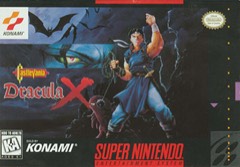
Richter Belmont, Simon's descendant, takes the family whip to Dracula's castle after the Count kidnaps Annet, the woman Richter loves, and her little sister Maria. The play is classic Castlevania: stiff jumps, sub-weapons, a whip that only cracks forward, and stages that branch into different routes.
How the story ends depends on you. Rescue both Annet and Maria, only Maria, or neither, and you see one of three different endings. Progress is kept by password, not save, and Richter is the only hero you control.
Where it sits in history
Konami had already made this story once, as Rondo of Blood on the PC Engine Super CD-ROM2 in Japan in 1993. That game could not simply be ported: a cartridge holds far less than a CD, and Konami had exclusivity agreements with NEC, the PC Engine's maker. So Dracula X borrows Rondo's plot and much of its art but builds new levels, with fewer of them, and drops Rondo's save files and its second playable character.
It came out in Japan on 21 July 1995, then in North America that September, and in Europe as Castlevania: Vampire's Kiss. Reviews were mixed. Most critics called it the lesser version of Rondo and too hard; Next Generation panned it outright. IGN's later look back was kinder, calling it still one of the best traditional Castlevania games.
How it plays today
Taken on its own, without Rondo hanging over it, Dracula X is a tight, tough, good-looking Castlevania. The colours are bright and the branching routes give you a reason to go back. Hunting the hidden paths to Annet and Maria turns a straight run into a search.
The difficulty is real, and critics at the time and since have blamed the level layouts for some of it. It asks for patience, not anger. If you can, play Rondo of Blood as well and treat this as its harder, smaller cousin.
Compared with
Why it matters
Dracula X is remembered as the game that was not Rondo of Blood. It was judged against a version most of its players had never seen, and it lost. That is a strange fate for a thing that works: what it was mattered less than what it was compared with.
Its difficulty is the other half of its reputation, and Jesper Juul's paradox of failure fits it closely. We avoid failing everywhere else, yet seek it here, because each death makes us look again at how we jumped. The game is hard, and players keep coming back to beat it anyway.
Read: One must imagine Mario happy →
- Juul, J. (2013). The Art of Failure: An Essay on the Pain of Playing Video Games. MIT Press.
What you're levelling up
You have been training these without noticing. Here is how to do it on purpose, and where it pays off away from the couch. All the skills games teach →
Curiosity
In the game. Stages branch, and hunting the hidden paths to Annet and Maria turns a straight run into a search. Three endings depend on who you rescue.
Do it on purpose. Next run, look for one route you haven't taken. Explore it even if you think it's a dead end.
Off the couch. Asking one more question about someone, or taking the long way round, is how you find the good stuff. People love being asked about themselves.
Keeping your cool
In the game. The difficulty's real and the level layouts own some of the blame. The game asks for patience, not anger.
Do it on purpose. After a cheap death, take five seconds and loosen your hands before you continue. Then play the bit again.
Off the couch. When something unfair happens at work or a date goes sideways, staying level is what lets you fix it. Losing it never does.
Pattern recognition
In the game. Classic Castlevania: stiff jumps and a forward-only whip mean you win by knowing what's coming, not reacting.
Do it on purpose. Pick one boss and describe its moves in order before you fight it again.
Off the couch. Spotting the loop, like how a mate always bails at 11, or what your spending does every Christmas, lets you get ahead of it.
Verdict · 7/10
A smaller shadow of Rondo of Blood, but a sharp, handsome Castlevania in its own right. Bring patience.