What it was
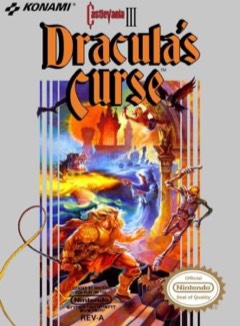
The year is 1476, Dracula is loose in Europe, and the exiled Belmont clan is called back to stop him. You play Trevor Belmont, Simon's ancestor, with the same whip, sub-weapons and deliberate jumps as the first game, across sixteen stages on the way to his castle.
Two things make it much more than a remake. First, the path forks: after the opening stage and at points later on, you choose which way to go, over the lake to the castle's front gate or through caverns and up the cliffs beneath it. Second, you can recruit one of three partners and play as them in Trevor's place. Sypha is a sorceress with weak attacks and strong spells, Grant is a pirate who climbs walls and steers mid-jump, and Alucard, Dracula's own son, shoots fireballs and turns into a bat. Only one can travel with Trevor at once, and the ending depends on who is with you.
Where it sits in history
Konami released it in Japan on 22 December 1989 as Akumajō Densetsu, in North America on 19 September 1990 and in PAL regions in May 1992. It is a prequel, set centuries before the original, and it dropped the role-playing wander of Castlevania II: Simon's Quest in favour of straight action.
The Japanese cartridge carried Konami's VRC6 sound chip, which added three extra channels, and its soundtrack is noticeably richer for it. Western NES consoles could not use extra sound chips, so the music was rearranged for the standard five channels. The Western release also made some enemies hit harder. The story later formed the basis of the first two seasons of the 2017 Castlevania animated series.
How it plays today
It is the most complete of the NES Castlevanias. The level design is varied and atmospheric, the branching routes and partners give it real replay value, and switching to Grant to climb past a hard section or to Sypha to torch a boss makes the stiff controls feel like a choice rather than a limit.
It is also very hard. Trevor still cannot adjust a jump once he leaves the ground, and the Western version's tougher enemies make the late stages a grind. The Japanese Famicom version, now officially available in the West, is both a little easier and sounds far better, and is the one we would start with.
Compared with
- Castlevania: The original is shorter and more focused; III keeps its feel and adds routes, partners and far more to see.
- Castlevania II: Simon's Quest: The adventure-RPG detour; III is the return to stage-based action most fans wanted.
- Super Castlevania IV: The SNES game is smoother and more forgiving, with a whip that swings in several directions; III has the bigger ideas.
Why it matters
Castlevania III has two soundtracks, and which one sounds like home depends on where you grew up. Japanese players heard it through Konami's VRC6 chip and its three extra channels. Everyone else heard a rearrangement squeezed into the NES's standard five. Meet the richer version decades later and it can feel strange: better, clearly, and somehow wrong.
That is nostalgia at work. Tim Wildschut and colleagues found it is mostly positive, often features close others, and raises our sense of connection and self-regard. And it clings to the version we lived with, not the best one. The thinner NES arrangement belongs to a particular bedroom, a brother who was better as Grant, a rental due back on Monday. The Famicom music has no such company yet. We still recommend the Famicom version, and mean it. But loyalty to the one you grew up with is not a mistake. It is the part of the game that was about you.
Read: Why old games feel like home →
- Wildschut, T., Sedikides, C., Arndt, J., & Routledge, C. (2006). Nostalgia: Content, triggers, functions. Journal of Personality and Social Psychology, 91(5), 975-993. doi:10.1037/0022-3514.91.5.975
What you're levelling up
You have been training these without noticing. Here is how to do it on purpose, and where it pays off away from the couch. All the skills games teach →
Planning ahead
In the game. The path forks: across the lake to the front gate or up the cliffs beneath. Only one partner travels with Trevor, and the ending depends on who.
Do it on purpose. Before a fork, say why you're picking that route and who you'll take. Next run, take the other one and compare.
Off the couch. Big choices, which job, which city, which course, look like this. Make one, commit, and know you can try the other path later.
Teamwork
In the game. Switch to Grant to climb past a hard section or to Sypha to torch a boss. Each partner covers a gap in what Trevor can do.
Do it on purpose. Play a stage using your partner for every hard bit, not just when you're stuck.
Off the couch. Knowing who's good at what and leaning on them is what makes a crew work. Same goes for a relationship: play to each other's strengths.
Bouncing back
In the game. Trevor still can't adjust a jump once he leaves the ground, and the late stages are a grind. It's very hard.
Do it on purpose. Count your deaths on one late stage. Next session, beat the count.
Off the couch. Being knocked back and going again is the whole game, at work and in love. Ask again, apply again.
Verdict · 9/10
The best Castlevania on the NES: hard, handsome and full of choices. Start with the Famicom version if you can.