What it was
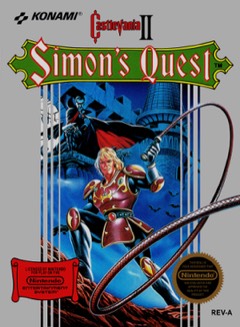
Seven years after the first Castlevania, Simon Belmont is dying of a curse Dracula laid on him. To break it, he must find Dracula's five body parts, hidden in five mansions, and bring them to the ruined castle to raise and kill him again. Instead of a run of stages, you get a world to wander: towns, forests, marshes and mansions, revisited as you like.
It borrows from role-playing games. Villagers give clues, and some of them lie. Merchants sell whips and weapons for the hearts that enemies drop, and collecting enough hearts raises Simon's level and health. Time passes: at night the towns fill with zombies and the monsters outside hit harder but drop more hearts. The body parts are tools too; Dracula's rib works as a shield. There are three endings, and the best one goes to players who finish within eight days of game time.
Where it sits in history
Hitoshi Akamatsu, who also directed Castlevania and Castlevania III, designed it. It came out on the Famicom Disk System in Japan in August 1987 as Dracula II, and he gave it the name Simon's Quest for the West. Asked about Metroid, Akamatsu named Konami's own The Maze of Galious as the influence instead.
The NES cartridge reached North America in 1988 and Europe in 1990. It used passwords where the disk version saved, and spent its extra space on better music, with percussion added to Kenichi Matsubara's score, including Bloody Tears, which has turned up in Castlevania games ever since. It sold over a million copies. Koji Igarashi later said the critical reaction to Simon's Quest helped him pitch Symphony of the Night, the game that shaped what people now call the Metroidvania.
How it plays today
The mood is wonderful. The music carries the whole thing, and wandering a cursed countryside with a whip feels like nothing else on the NES. The heart economy and the slowly stronger Simon give real reasons to fight.
The puzzles are the problem. The English clues are cryptic and sometimes wrong, and a few secrets have no clue at all: at one cliff you must summon a tornado with the right crystal, and nothing tells you so. Even the original Japanese villagers were meant to lie. Bosses are easy and the backtracking is long. Play it with a map and a guide open, and it becomes a fine, eerie adventure.
Compared with
Why it matters
Simon's Quest is a game about not being told. Villagers lie, signs are vague, and the world will not explain itself. Retrospective reviews say it needs a walkthrough.
Juul writes that failure in games is what makes us stop, rethink and get better. Here, failing to understand was the design, for better and worse. It shows the thin line between a mystery that pulls you in and a puzzle that shuts you out, and how often the answer is to ask someone else.
Read: One must imagine Mario happy →
- Juul, J. (2013). The Art of Failure: An Essay on the Pain of Playing Video Games. MIT Press.
What you're levelling up
You have been training these without noticing. Here is how to do it on purpose, and where it pays off away from the couch. All the skills games teach →
Problem solving
In the game. Villagers give clues and some of them lie. At one cliff you need to summon a tornado with the right crystal, and nothing tells you.
Do it on purpose. Before you open a guide, list everything you haven't tried. Give yourself a day before looking it up.
Off the couch. Life's full of advice that's half wrong. Being able to sift it, try things and work it out is the skill that makes you the one people ring.
Reading people
In the game. Some villagers lie, even in the Japanese original. Working out who to trust is part of the game.
Do it on purpose. Write down every clue and mark the ones you think are dodgy. Check later how you did.
Off the couch. Learning who's straight with you and who isn't saves you money, jobs and heartache. Watch what people do, not just what they say.
Planning ahead
In the game. Time passes: night brings tougher monsters but more hearts. The best ending is for finishing inside eight days of game time.
Do it on purpose. Decide before each night whether you're farming hearts or heading somewhere safe. Stick to it.
Off the couch. Knowing when to grind and when to rest is a work skill and a money skill. Plan your week and you'll have more of a weekend.
Verdict · 6/10
A brave, broken and beautiful sequel, more important than it is fun. Play it with a guide, for the music and the night.