What it was
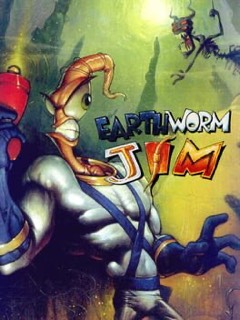
Jim is an ordinary earthworm until a super suit falls out of the sky. Now his worm body is the head and the suit is everything else, and every villain in the galaxy wants the suit back. He sets out to meet Princess What's-Her-Name. Early on he launches a cow into space. Remember the cow.
It plays as a side-scrolling platformer with a gun. Jim shoots, and he also cracks his own worm body like a whip, which hits enemies and lets him swing from hooks. The levels refuse to stay the same. In one you escort Peter Puppy, whipping him over pits, and if anything hurts him he turns on Jim. Between most levels Jim races Psy-Crow on a rocket through an asteroid tube, seen from behind, and if he loses, he has to beat Psy-Crow in a fight instead. There is a bungee-jumping duel and an underwater maze against the clock.
The bosses are a cast list on their own: Queen Slug-for-a-Butt, Evil the Cat, Bob the Killer Goldfish, Professor Monkey-for-a-Head.
Where it sits in history
Playmates Toys, flush from the Teenage Mutant Ninja Turtles licence, wanted a franchise of its own and chose to start it as a video game. Doug TenNapel brought a sketch of a worm to Shiny Entertainment. David Perry's team bought the rights, TenNapel designed levels and voiced Jim, and the programmers built the rest. Shiny had only ever made licensed games such as Cool Spot, and this was their chance to make fun of the genre: the princess is a parody of every throwaway princess in every platformer.
Perry programmed most levels on the Genesis first, and Nick Jones converted them to the Super NES. The Genesis version came out in October 1994, the Super NES one shortly after, and the Super Famicom version in Japan on 23 June 1995, published by Takara. The Super NES version has different backgrounds and effects, but lacks some sound effects and the level Intestinal Distress.
Electronic Gaming Monthly praised both versions for the animation, the long levels and the warped humour, and one reviewer said it was clearly made by a gamer. It sold more than a million copies by 1995. Total! ranked it 14th of the top 100 Super NES games that year, and IGN later ranked it 57th.
How it plays today
The animation is still the first thing you notice. Jim is hand-drawn and never stops moving, and the backgrounds look like a cartoon somebody painted at three in the morning, which, in the case of the giant hamster, is roughly what happened.
The play is less even than the art. The run-and-gun parts are solid, the Peter Puppy level is funny once and tense every time after, and the asteroid races are the bit you will want to skip. But it never bores you, because the next level is always some new idea.
Compared with
- Earthworm Jim 2: The 1995 sequel, released the same way: Genesis first, then the rest.
- Cool Spot: Shiny's earlier licensed platformer, the kind of game Jim was made to mock.
- Sparkster: Another 1994 Super NES platformer where the hero shoots and the stage idea changes every few minutes.
Why it matters
Shiny's team had spent years making games to someone else's limits. Given a worm and no rules, they made a joke about the whole medium, and the joke was so full of care that it became the thing it was mocking.
Winnicott saw play as the space between the inner world and the outer one, where people are creative and find a self. Earthworm Jim reads like a studio finding its self in exactly that space. You can feel the people behind it, and that is why it still makes players laugh thirty years on.
Read: Who you are when you play →
- Winnicott, D. W. (1971). Playing and Reality.
What you're levelling up
You have been training these without noticing. Here is how to do it on purpose, and where it pays off away from the couch. All the skills games teach →
Timing and rhythm
In the game. Jim cracks his own worm body like a whip to hit enemies and swing from hooks. Grab the hook a beat late and you're in the pit.
Do it on purpose. Find a run of hooks and swing it over and over until you're watching the next hook, not Jim.
Off the couch. A tennis swing, a tackle, merging on the freeway: all timing. Feel the beat and you stop rushing.
Keeping your cool
In the game. In one level you whip Peter Puppy over pits, and if anything hurts him he turns on Jim. Funny once, tense every time after.
Do it on purpose. Play the Peter Puppy level slowly on purpose. Every time you feel rushed, stop, let him walk, then act.
Off the couch. Getting a mate home after they've had a few too many. Calm and steady gets everyone there; flapping makes it worse.
Making things
In the game. Doug TenNapel brought Shiny a sketch of a worm, and a team used to making licensed games built one that takes the mickey out of platformers, right down to Princess What's-Her-Name.
Do it on purpose. After a session, sketch your own boss in the Jim style: a name like Bob the Killer Goldfish and one silly attack. Show a mate.
Off the couch. Making stuff gives you something real to talk about. 'I've been drawing this ridiculous worm' beats 'I watched some shows' on any date.
Verdict · 8/10
A parody of platformers that turned out to be one of the best of them. Come for the cow, stay for the worm.