What it was
Before you meet the hero, you live four other lives. A royal soldier named Ragnar hunts for missing children with a friendly slime at his side. Princess Alena slips out of her castle to prove she can fight. Torneko, a merchant, works the counter of a weapon shop and dreams of owning his own. Two sisters, the dancer Maya and the fortuneteller Meena, chase the man who murdered their father. Only in the fifth chapter does the hero escape a village overrun by monsters, and the others come to join them.
Chunsoft built it on Dragon Warrior III's bones: a day and night cycle, ships, a flying vehicle (a hot air balloon this time). New were the wagon, which lets you swap fighters in and out of battle, and a Tactics system: in the last chapter your companions act on their own, following an order such as save magic or heal first. The first casino in the series is here, and so are the small medals hidden in drawers and jars, traded for rare gear.
Where it sits in history
Enix released it on the Famicom in Japan on 11 February 1990. 1.3 million cartridges sold out within an hour, and the game went on to sell 3.1 million copies there, fourth best on the system. Akira Toriyama drew the promotional art and Koichi Sugiyama wrote the music; the battle theme swells from soft to loud, a crescendo rare on the NES.
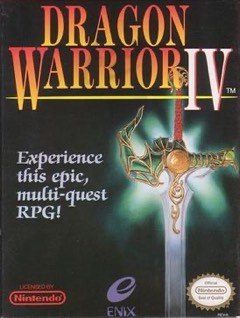
Enix's American arm brought it out in October 1992 as Dragon Warrior IV. It sold about 80,000 copies. It was Enix America's last Dragon Quest before the office closed, and no Dragon Quest reached English again until Dragon Warrior Monsters in late 1999. The merchant proved the breakout star: Torneko got his own spin-off series, Torneko's Great Adventure, which grew into the Mystery Dungeon games.
How it plays today
The chapters are the reason to play. Each is a short, complete adventure with its own small party and its own music, and none outstays its welcome. Torneko's is the oddest and the best: you can earn your keep by standing in a shop selling to customers.
Chapter five asks more patience. The AI companions in the original can't be steered directly, and you won't always agree with their choices. The menus are slow by modern standards. Still, it is the warmest of the NES Dragon Warriors and the one where the series learned to tell a story through its people.
Compared with
- Dragon Warrior III: The previous game's world systems carried forward; this one swaps a party you build for one you meet.
- Final Fantasy IV: Square's next big RPG, out the following year on the Super Famicom.
- Dragon Warrior II: Where the series first put a party together; DQIV gives each member a life before the party.
Why it matters
Bernard Suits described playing a game as 'the voluntary attempt to overcome unnecessary obstacles'. Torneko's chapter puts that to the test. In a world of monsters and kings, the game hands you a shop counter, customers and a savings goal, and players take it up gladly. Critics noticed how strange it was: a chapter whose only aim is to make money.
The chore isn't the point. The choosing is. Work you are made to do and work you pick up for fun can look the same from outside, and Dragon Warrior IV shows how much a free choice changes the feel of a day behind the till.
Read: The magic circle: the world that rules make →
- Suits, B. (1978). The Grasshopper: Games, Life and Utopia.
What you're levelling up
You have been training these without noticing. Here is how to do it on purpose, and where it pays off away from the couch. All the skills games teach →
Story sense
In the game. Before you meet the hero you live four other lives: Ragnar hunting missing kids, Alena sneaking out to fight, Torneko behind a shop counter, and Maya and Meena chasing their father's killer.
Do it on purpose. At the end of each chapter, say in one sentence what that character wants. In chapter five, notice how it changes how you see them.
Off the couch. Everyone you meet is the hero of their own chapter. On a date, ask about theirs before you tell yours and you'll be the most interesting person they've talked to all week.
Teamwork
In the game. In the last chapter your companions act on their own, following orders like save magic or heal first. You can't steer them directly, so you set the plan and trust it.
Do it on purpose. Pick one Tactics order per fight on purpose and watch what each companion does with it. Change it only when you can say why.
Off the couch. Running a team at work is the same: give a clear brief, then let people work. Micromanage and everyone's miserable, including you.
Planning ahead
In the game. Torneko's chapter hands you a shop counter, customers and a savings goal. You can earn your keep just standing there selling.
Do it on purpose. Set a target before Torneko's chapter: how much gold by which point. Check it every time you save.
Off the couch. A savings goal with a date on it, for a car or a trip. Boring, maybe. But the one with money put aside gets to say yes when something good comes up.
Verdict · 8/10
Five short adventures that fold into one long one, and the best RPG on the NES. Play the DS or phone version if the original's AI wears you down.