What it was
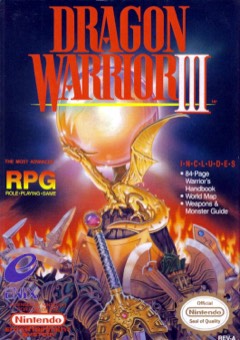
On your sixteenth birthday the King of Aliahan sends you after Baramos, the archfiend your father Ortega went after and never came back from. You choose to play a son or a daughter. Then you walk into the tavern and build the rest of your party yourself: Soldier, Fighter, Pilgrim, Wizard, Merchant, Goof-Off, Sage, each recruit's job chosen by you. At level 20 any of them can change class at the temple of Dhama, starting again at level 1 with half their stats but keeping their spells, so a Wizard can become a Soldier who still knows magic.
The world is ours, lightly disguised: Romaly for Rome, Portoga for Portugal, Jipang for Japan. Days turn to nights, and some people, items and quests are only there at certain times. Beat Baramos and the story turns: his master Zoma appears and opens a pit into a dark world below, and that dark world is Alefgard, the land of the first Dragon Warrior. You are not just a hero. You are Erdrick, the legend the other two games were about.
Where it sits in history
Chunsoft made it for Enix, with Yuji Horii writing, Akira Toriyama drawing and Koichi Sugiyama scoring. Horii dropped the long passwords of the first two games for save slots, because he disliked making players copy codes down, and later said the series' structure was perfected here.
It came out in Japan on 10 February 1988 and sold 1.1 million cartridges on the first day and 3 million in a week; nearly 300 students were arrested for truancy, skipping school to buy it. The often-told story that the government then banned weekday Dragon Quest releases is a myth: Enix chose weekends itself. It sold 3.8 million in Japan. The NES version reached North America in 1992, when 16-bit consoles were already out, and sold about 95,000 copies.
How it plays today
Better than the first two, and still very much a 1988 RPG. Building your own party and planning class changes gives it a long tail the earlier games lack, and the twist into Alefgard still lands if you played the first game.
The NES version keeps the series' clumsy menus and plain look, which critics have long called out, and the grind between towns is real. The recruits have no story of their own; they are what you make them. For most people a remake is the better way in, but the original is all there and it holds together.
Compared with
- Dragon Warrior: The game this one sets up; play it first and the twist means more.
- Dragon Warrior II: Three fixed heroes and a brutal end game; this one hands you the party.
- Final Fantasy: Square's party RPG, out in Japan two months before this one.
Why it matters
James Paul Gee describes a projective identity in games: not quite you and not quite the character, but a blend, shaped by what you want that character to be. Dragon Warrior III leaves room for exactly that. The heroes in your party have no lines and no backstory. You picked who joined, you picked their jobs, you decided the Wizard should become a Soldier. Whatever they are by the end, you made them.
And then the game tells you that the hero you built is a legend. It is a kind thing to tell a player.
Read: Who you are when you play →
- Gee, J. P. (2003). What Video Games Have to Teach Us About Learning and Literacy.
What you're levelling up
You have been training these without noticing. Here is how to do it on purpose, and where it pays off away from the couch. All the skills games teach →
Planning ahead
In the game. At level 20 anyone can change class at Dhama, starting again at level 1 with half their stats but keeping their spells. A Wizard turned Soldier who still knows magic is a plan you make hours ahead.
Do it on purpose. Before you hire a recruit at the tavern, plan their class path. Write down the level you'll switch at, and stick to it.
Off the couch. Changing careers works the same way. You keep what you learnt, take a step back, then grow faster. Knowing that makes the jump a lot less scary.
Curiosity
In the game. Days turn to nights, and some people, items and quests only show up at certain times. Romaly, Portoga and Jipang are our world in a light disguise.
Do it on purpose. Walk through one town by day, then again at night, and talk to everyone both times. Note what changed.
Off the couch. On a date, ask about the place they grew up, then ask a second question about the answer. That follow-up is where the curious stand out from the ones just waiting to talk.
Story sense
In the game. Beat Baramos and the floor drops out. Zoma opens a pit into Alefgard, the land of the first game, and you learn you're Erdrick. The legend was you all along.
Do it on purpose. Read up on the first Dragon Warrior's story before the twist lands. Afterwards, tell a mate the whole trilogy in two minutes.
Off the couch. A good yarn at the pub is all setup and payoff. Know where you're heading and hold the punchline back.
Verdict · 8/10
The high point of the Erdrick trilogy and the game that made Dragon Quest a national event. Dated in its menus, timeless in its shape.