What it was
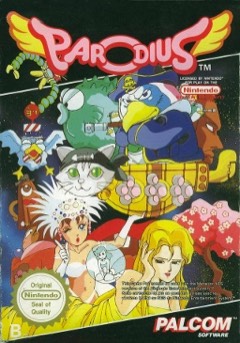
The name is Parody plus Gradius, and that is the whole idea. It plays like a Gradius game, with the same power meter and the same left-to-right flight, but everything you see and hear is deliberately absurd. The Big Core boss becomes a neon Viva Core. The moai heads are back, now animated, and the moai boss Yoshiko attacks by spitting smaller moai out of her mouth.
You pick one of four pilots, and each one carries a weapon set from a different Konami shooter: the Vic Viper from Gradius, an octopus with Salamander's weapons, TwinBee with its own series' weapons turned sideways, and Pentarou with a set from Gradius II. Bells from TwinBee add one-off powers, such as clearing the screen or firing a huge beam.
The music is half the joke. Stage after stage sets Konami's shooting to classical pieces: Strauss, Tchaikovsky, Rossini, Bizet and, more than once, Flight of the Bumblebee, mixed with old Gradius themes.
Where it sits in history
Parodius Da! began in Japanese arcades in 1990, where it was one of the five highest-grossing arcade games of the year and won Gamest's awards for best production and best shooting game. Its Japanese title means From Myth to Laughter. It was the second Parodius; the first was an MSX game in Japan.
The Super Famicom port came out in Japan on 3 July 1992 and in Europe and the rest of the PAL region the same year as Parodius: Non-Sense Fantasy. It adds two stages the arcade game lacks: a bath house, and an extra stage called Omake, renamed Lollipop in the PAL version, where you carry on straight away after dying instead of returning to a checkpoint. It was never released in North America.
Mean Machines gave the SNES version 93 per cent and Computer and Video Games 88. Power Unlimited said Konami was poking fun at its own games without forgetting the gameplay. In 1996 Super Play ranked it 93rd in its top 100 SNES games.
How it plays today
Under the jokes, it is a properly made Gradius game, and that is why it holds up. The stages are inventive, the weapon sets feel different from each other, and the bosses are as silly to look at as they are fun to fight.
It is also a good first shooter for someone who finds Gradius grim. The tone tells you it is fine to die, laugh and go again.
Compared with
- Gradius III: The serious SNES Gradius it is having a laugh at.
- Gradius II: The source of Pentarou's weapons and several remixed themes.
- Pop'n TwinBee: Konami's other cheerful SNES shooter, from the series that lent Parodius its bells.
Why it matters
Caillois placed play on a line from paidia, free and silly, to ludus, bound by rules. Gradius sits at the strict end: learn the pattern, follow the order, do not slip. Parodius keeps every one of those rules and pulls the mood all the way back towards the other end, with penguins and polka.
It is a reminder that rules and fun are not opposites. The same discipline that makes Gradius serious makes Parodius funny, because you have to know the straight version to laugh at the joke.
Read: The magic circle: the world that rules make →
- Caillois, R. (1958/1961). Man, Play and Games (trans. M. Barash).
What you're levelling up
You have been training these without noticing. Here is how to do it on purpose, and where it pays off away from the couch. All the skills games teach →
Pattern recognition
In the game. Under the jokes it's a properly made Gradius game. The Viva Core and Yoshiko spitting moai still run fixed patterns you can learn.
Do it on purpose. On one boss, spend a run just watching. Say its attack order out loud, then beat it.
Off the couch. Finding the order in what looks like chaos helps with study, work and figuring out a new city.
Bouncing back
In the game. The tone tells you it's fine to die, laugh and go again. It's a good first shooter for someone who finds Gradius grim.
Do it on purpose. Set a goal of three runs in a row and laugh at each death instead of swearing. See if you get further.
Off the couch. Laughing off a stuff-up is attractive. Nobody wants to date or work with someone who melts down over a small mistake.
Judging risk
In the game. Four pilots, each with a weapon set from a different Konami shooter, plus TwinBee bells with one-off powers like clearing the screen.
Do it on purpose. Save a screen-clearing bell for the hardest moment of a stage instead of using it straight away. Note if it changes the outcome.
Off the couch. Keeping something in reserve for a rough patch, money or energy, is the habit that gets you through bad months.
Verdict · 8/10
A comedy that is also a very good shooter, which is the hardest kind of comedy to make. Find the Super Famicom or PAL cartridge.