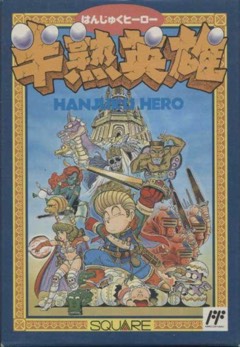
What it was
A young man wakes near a cliff with no memory. A stranger named Amachi found him and took him in. Soon he learns he is a detective's assistant, sent to a remote village to look into the death of Kiku Ayashiro, the head of a wealthy landowning family. The locals repeat an old saying: the dead will rise to kill anyone who tries to take the Ayashiro fortune. Then more people start dying.
Famicom Detective Club is a text adventure. You pick commands from a menu (Ask, Examine, Take, Show, Go) and point a cursor at the scene to search it, while dialogue scrolls in a box at the bottom. Only commands that make sense appear at each moment. Now and then the game asks you a question and you spell out the answer letter by letter. This disk, the zenpen or first part, holds the opening half of the story; the second disk followed seven weeks later.
Where it sits in history
Nintendo released the first disk of The Missing Heir for the Famicom Disk System on 27 April 1988 and the second on 14 June. It was Yoshio Sakamoto's first writing job, before he became best known for Metroid, and he calls it a turning point. Gunpei Yokoi gave him little more than a title to work from. Sakamoto wrote the whole scenario by hand in book form before development began, drawing on Enix's The Portopia Serial Murder Case, the horror films of Dario Argento and the rural murder novels of Seishi Yokomizo. Its working title was Corpse Village.
A prequel, The Girl Who Stands Behind, followed in 1989. Both stayed in Japan until Mages remade them for Nintendo Switch in 2021, with English text on the same day as the Japanese release. Sakamoto returned to write a new entry, Emio – The Smiling Man, in 2024.
How it plays today
The mood carries it. The village, the feuding family and the ghost story give it a slow, creeping tension, and the writing is tight for a game of its time. It clearly owes a debt to Japanese mystery novels, and it wears that well. Being split across two disks, the first half ends just as the case deepens, which is good pacing and a nuisance if you only own one disk.
As a game, it is simple and sometimes stubborn. Progress often means trying every command on every person until something new happens, and the original is in Japanese with no official translation. Unless you read Japanese, the Switch remake is the realistic way in, with new art, music and voiced dialogue on the same story.
Compared with
- Famicom Tantei Club Part II: Ushiro ni Tatsu Shōjo: The prequel moves to a school ghost story, and Japanese critics singled out its scary school setting.
- Shadowgate: A Western menu-driven adventure on the NES, heavier on puzzles and traps than on story.
- Déjà Vu: Another amnesiac detective adventure on the NES, noir rather than rural gothic.
Why it matters
A young man wakes near a cliff with no memory, and a village repeats that the dead will rise to kill anyone who reaches for the Ayashiro fortune. Famicom Detective Club builds its dread from a menu: Ask, Examine, Take, Show, Go. It shouldn't be frightening. It is.
Johan Huizinga described play as free and bounded, set apart from ordinary life in a magic circle with its own order. A mystery is one of the tidiest circles there is. Inside it, every object might matter, every villager might lie, and the rules promise the truth can be found by asking the right thing. Real life offers no such guarantee. Yoshio Sakamoto wrote the whole scenario by hand before development began, and the order shows. That is the comfort inside the chill: a world that is dark but solvable, where paying attention always pays. Then the story stops halfway, because the second disk came seven weeks later, and the circle stays open in your head.
Detective games ask you to spot the liar from how a suspect talks. Real people are bad at it: observers catch lies at about chance, and hesitation and stumbling, the cues we trust most, turn up more in truthful testimony than in lies. A 2026 paper calls this the Signal Inversion Effect.
Read: The magic circle: the world that rules make →
- Huizinga, J. (1938/1949). Homo Ludens: A Study of the Play-Element in Culture.
- Astor, T. (2026). The Signal Inversion Effect. OSF Preprints. doi:10.31219/osf.io/ed4nc_v1
What you're levelling up
You have been training these without noticing. Here is how to do it on purpose, and where it pays off away from the couch. All the skills games teach →
Problem solving
In the game. You pick from Ask, Examine, Take, Show and Go, and progress often means trying every command on every person until something new happens.
Do it on purpose. When you're stuck, write down who you haven't shown what. Work through the list in order instead of clicking at random.
Off the couch. A weird bug at work, or the car making a new noise. List what you know, list what you haven't tried, work down it. Calm process beats panic.
Reading people
In the game. A feuding family, a village ghost story and a growing body count. Any villager might be lying, and the game rewards whoever listens properly.
Do it on purpose. Before you Ask someone a thing, guess what they'll say and whether they're hiding something. Track your hit rate across the case.
Off the couch. Noticing when someone dodges a question, or lights up about something, is most of being good company. Listen more than you talk on a first date and you'll catch it.
Picking up a language
In the game. The original is in Japanese, but the menu is only five commands: Ask, Examine, Take, Show, Go. Learn those and you can move.
Do it on purpose. Learn the kana for the five commands first, then keep a notebook of every name and word you work out from the dialogue box.
Off the couch. Even a bit of Japanese makes a trip there twice the fun, and it's a solid talking point in a job interview.
Verdict · 7/10
A moody, well-written mystery that set Sakamoto on his way, split awkwardly across two disks. Play the remake unless you read Japanese.