What it was
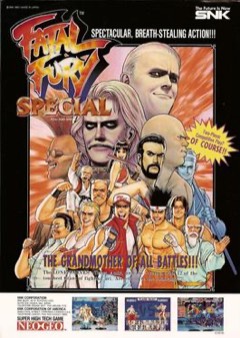
Fatal Fury Special is Fatal Fury 2 with the lot turned up. The four bosses become playable, three fighters from the first game return in Tung Fu Rue, Duck King and Geese Howard, and the roster hits fifteen. It also adds a combo system: land a hit, and you get a brief moment of invincibility to chain the next one. The game speeds up as well.
In single player you fight the eight regular fighters from the last game plus Tung and Duck. Then Billy, Axel, Laurence, Geese and Krauser, in that order. Win every match in two rounds and you earn a Dream Match against Ryo Sakazaki, the hero of Art of Fighting.
Where it sits in history
SNK released it for the Neo Geo in 1993. Ryo's cameo is the famous bit: the crossover is what inspired SNK to make The King of Fighters, whose first game arrived a year later. The SNES port came to Japan on 29 July 1994, and Playmates Interactive Entertainment handled North American distribution.
The arcade game was Japan's third highest-grossing of 1994. Reviewers loved the Neo Geo original. They were less kind to the SNES one. All four Electronic Gaming Monthly reviewers complained about a heavy echo effect in the audio and said some moves were hard to pull off, though they judged it a good conversion overall. GamePro said the graphics and controls were vastly inferior to the Neo Geo version. Next Generation marked it down for lack of originality. A 1996 Maximum retrospective said Special tweaked Fatal Fury 2 very superficially, with the main selling point the number of fighters, though they liked the hectic pace.
How it plays today
The roster is the reason to be here. Next Generation counted fifteen characters with five specials apiece, which is a lot of cartridge, and the combo window gives the fights a rhythm the earlier games lacked. If you can live with the echo, it is the one to pick.
It won't make anyone forget Street Fighter II, but it has its own pace and plenty of weird characters. Great for a night with a mate, and for playing everyone at least once.
Compared with
Why it matters
Ryo showing up at the end of a different series sold a feeling that games do well: worlds are shared, and your favourite things might know each other. The crossover went down so well that SNK built a whole series on it.
Durkheim called it collective effervescence, the charged energy of people gathered around one thing. Goffman wrote that a game makes a shared little world, and that being absorbed in it together is what makes an encounter feel alive. A Dream Match is both in miniature: the secret fighter walks out and everyone in the room leans in.
Read: The second controller →
- Durkheim, E. (1912). The Elementary Forms of Religious Life.
- Goffman, E. (1961). Encounters: Two Studies in the Sociology of Interaction ('Fun in Games').
What you're levelling up
You have been training these without noticing. Here is how to do it on purpose, and where it pays off away from the couch. All the skills games teach →
Timing and rhythm
In the game. Landing a hit gives a brief moment of invincibility, so a combo only works if the next input goes in right on cue.
Do it on purpose. Pick one two-hit chain and drill it until it comes out on cue ten times in a row.
Off the couch. A conversation has a combo window too. Follow up on what someone just said while it's still warm, and the chat keeps flowing. Wait too long and it drops.
Systems thinking
In the game. Fifteen fighters means fifteen sets of tools. The four former bosses are now playable, and you have to work out how each one beats the others.
Do it on purpose. Pick the fighter you like least and work out which two characters beat them.
Off the couch. Every share house has a matchup chart: who gets on, who clashes over the dishes, who calms it down. See it and you can stop a blue before it starts.
Curiosity
In the game. Finishing in two rounds every match unlocks a Dream Match with Ryo, and that only happens if you go looking.
Do it on purpose. Play the one mode on the menu you've been skipping.
Off the couch. Say yes to the cuisine, sport or hobby you reckon you'd hate. Half the time there's a Dream Match behind it, and the best stories come from the nights you nearly skipped.
Verdict · 7/10
A big roster and a combo system on a cartridge with a noisy audio problem. Pick it over the second game if you want the most fighters.