What it was
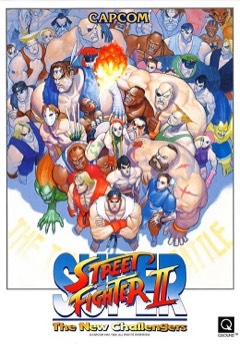
This is the fourth Street Fighter II, and the one that finally grew the roster. All twelve World Warriors return, many with moves trimmed or tuned for balance, and some with new specials: a flaming Hadoken for Ryu, a flaming Shoryuken for Ken, Zangief's Atomic Buster. Then come four new faces. Cammy, a young special forces agent from England with a past tied to M. Bison. T. Hawk, a warrior whose homeland Shadaloo took. Dee Jay, a Jamaican kickboxer hunting for his next song. Fei Long, a Hong Kong film star modelled on Bruce Lee.
Everything else got a fresh coat: new stages, portraits and menus, remade music and sound, a new announcer, a score system that rewards combos, first hits and reversals, and eight colour choices per fighter. The speed came down, back to the pace of Champion Edition rather than Turbo's rush.
Where it sits in history
Capcom showed the arcade game at Japan's JAMMA show in August 1993, the first release on its new CP System II board, and launched it with a tournament that drew 1,300 players a day in Japan. The arcade version could link four cabinets for an eight-player knockout.
The Super NES version arrived in Japan on 25 June 1994, on a 32-megabit cartridge, with the Genesis version out alongside it. It kept the eight-player tournament and added Group Battle and Time Challenge, with several speeds to choose from; Nintendo's rules swapped the blood on beaten portraits for sweat. The Super Famicom version was the third best-selling game of 1994 in Japan, and the Super NES version sold two million copies worldwide. Electronic Gaming Monthly called it the best Street Fighter II yet, while wishing Capcom had made Street Fighter III instead.
How it plays today
Of the three Street Fighter II games on the Super NES, this is the fullest box. Sixteen fighters is a big jump, and the newcomers earn their place; Gamest ranked Cammy fifth among the best characters of 1993, months before she reached a home console. The slower speed suits a pad and a couch; you have time to see what is coming.
The music is the weak spot. As on the Super NES Turbo, it stops between rounds and starts over, which wears thin in a long session. But the tournament mode is the hidden treasure: eight friends, one console, a bracket. That is a party, not a menu option.
Compared with
Why it matters
Capcom built this game so eight people could play one bracket on one machine. In the arcade that took four linked cabinets; at home it took a controller passed down a row of friends. Durkheim wrote about collective effervescence, the charged shared energy that runs through people gathered in a single activity and binds them together. Anyone who has been in a room when an underdog wins the final round knows the feeling: the shout goes up from everyone at once.
A fighting game looks like two people against each other. The tournament mode shows what it really is: a crowd, held together by the match in the middle.
Read: The second controller →
- Durkheim, E. (1912). The Elementary Forms of Religious Life.
What you're levelling up
You have been training these without noticing. Here is how to do it on purpose, and where it pays off away from the couch. All the skills games teach →
Reading people
In the game. The speed came back down to Champion Edition pace, so you actually have time to see what's coming. Use it to watch the person on the other pad.
Do it on purpose. Pick a mate's main and spend one round only blocking and watching. Name their favourite move out loud, then punish it next round.
Off the couch. Watching before you speak is half of being good in a meeting and most of being good on a date. People can tell when you've actually noticed them.
Winning and losing well
In the game. Tournament mode takes eight friends, one console and a bracket. Somebody's going out in round one in front of everyone.
Do it on purpose. Run a bracket this weekend. Whoever knocks you out, say 'good game', then ask them what beat you.
Off the couch. Going out early and staying a good laugh for the rest of the night is rare. It's exactly what people remember about you.
Curiosity
In the game. Four new faces join the twelve World Warriors: Cammy, T. Hawk, Dee Jay and Fei Long. Plenty of players still never leave Ryu.
Do it on purpose. Play a whole night as a newcomer you've never touched. Write down three things you worked out about them.
Off the couch. Trying the thing you'd normally skip, a new sport, a mate's hobby, an elective at uni, is how life gets bigger. Interesting people are the ones who tried stuff.
Verdict · 9/10
The most complete Street Fighter II on the Super NES, if not the quickest. Sixteen fighters and a tournament mode made for a full lounge room.