What it was
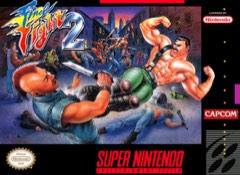
The Mad Gear gang is back under a new leader, Retu. They kidnap Rena, Guy's fiancée, and her father Genryusai, Guy's old teacher, in Japan. Rena's younger sister Maki rings Mayor Haggar, and he flies out with his friend Carlos Miyamoto. The three fight across six stages: Hong Kong, France, Holland, England, Italy and finally Japan.
It plays like Final Fight. One button attacks, one jumps, and both together fire a special move. Haggar wrestles, Maki fights like Guy did in the first game, and Carlos swings a sword for his special. Barrels and drums hide food and points, and there are three weapons to pick up: a tonfa, a length of timber and a knife. A Guy doll gives an extra life, and a Genryusai doll makes you briefly untouchable.
Where it sits in history
There was no arcade Final Fight 2. Capcom's consumer division made it for the Super Famicom, where it came out in May 1993, reaching North America that August and PAL countries in December. It sold 399,756 copies in Japan and passed a million worldwide by May 2001, one of Capcom's best sellers on the system.
Rolento, a boss cut from the first SNES port, returns as 'Rolent'. The difficulty setting also decides how much of the ending you see; only Expert shows it all. As with the first game, the English release changed things: two knife-throwing female enemies, Mary and Eliza, became Leon and Robert, and the first boss, Won Won, lost his meat cleaver. The game came to the Wii Virtual Console in 2009.
Reviews were middling. GamePro liked the graphics but found the music below the first game's and the fighting predictable. Later lists were kinder: GamesRadar called it the Final Fight it had always wanted, and Complex said it beat its predecessor in every way.
How it plays today
This is the console Final Fight people wished for in 1991. The second player is back, the stages are full, and the trip around the world gives each level its own look. The fighting is honest and readable: a crowd arrives, you work through it, you move on.
It is also safe. Very little here surprises you if you have played the first game, and the music does not hit like Metro City's. Alone it can feel like routine work. With a friend on the second pad it is a solid, cheerful evening.
Compared with
Why it matters
Final Fight 2 exists because a feature went missing. The first cartridge could not keep two players on screen, and the sequel's answer was to start again on the console and put the friend first. Even its options say who it is for: a code lets two players pick the same fighter, so nobody has to give up their favourite.
Goffman wrote that a game builds a small shared world with its own rules, and that being caught up in it together is what makes an encounter feel alive. A beat 'em up for one is a list of chores. The same stages with someone beside you become a shared story about who saved whom in Holland.
Read: The second controller →
- Goffman, E. (1961). Encounters: Two Studies in the Sociology of Interaction ('Fun in Games').
What you're levelling up
You have been training these without noticing. Here is how to do it on purpose, and where it pays off away from the couch. All the skills games teach →
Teamwork
In the game. The second player is back, and a code lets two players pick the same fighter so nobody gives up their favourite.
Do it on purpose. Play with a mate and call your side for every crowd: 'I've got left'. Leave the chicken for whoever's lower on health.
Off the couch. Couch co-op makes a great night in: on their side, calling it out, leaving them the chicken. Being a good teammate says more about you than any line.
Judging risk
In the game. Attack and jump together fires a special that clears the space around you. Knowing when to burn it and when to keep punching is the whole fight.
Do it on purpose. Play a stage allowed only three specials. Save them for when you're surrounded and notice how much health you keep.
Off the couch. Favours work the same. Every one you call in costs a bit, so save them for when you're actually surrounded.
Pattern recognition
In the game. The fighting is honest and readable: a crowd arrives, you work through it, you move on, from Hong Kong all the way to Japan.
Do it on purpose. Pick one enemy type and watch it for a whole stage. Say what it does before it attacks, then punish it.
Off the couch. Every workplace has a rhythm: flat-out Mondays, quiet Fridays, the boss stressed before the board meeting. Spot it and you time your asks better.
Verdict · 7/10
Final Fight 2 gives back the second player the first port took away, and that matters more than anything else it does. A sound, unadventurous brawler that is much better shared.