What it was
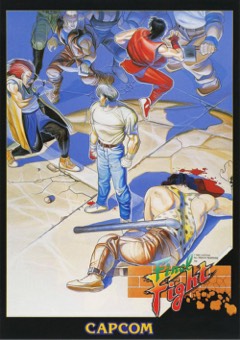
Metro City has a new mayor, Mike Haggar, a former pro wrestler cleaning up the streets. The Mad Gear gang answers by kidnapping his daughter Jessica. Haggar and her boyfriend Cody go after them, through the slums, the subway and up to the gang's leader, Belger. One button attacks, one jumps; grab a thug to knee him or throw him, and smash barrels for pipes, knives, swords and food that restores health.
Each fighter plays differently. Haggar grabs, with a spinning piledriver that is the strongest move in the game without a weapon. Cody can keep stabbing with a knife where others throw it. A spinning attack clears a crowd but costs some health, so it is a choice, not a free escape.
Where it sits in history
Final Fight began as a Street Fighter sequel, and Capcom showed it at trade shows as Street Fighter '89. Operators said it played nothing like Street Fighter, so it was renamed before release. Akira Nishitani designed it and Yoshiki Okamoto produced it; Okamoto pointed to Double Dragon II as the starting point, and the team watched Walter Hill films, Streets of Fire above all, for the look of the city. Many of the gang are named after 1980s rock musicians, and Hugo is modelled on André the Giant.
The arcade game was the highest-grossing of 1990 in Japan. Capcom made the Super Famicom version a launch title there in December 1990; it reached North America in 1991 and PAL countries in 1992, and sold 1.5 million copies. The cartridge could only show two or three enemies at once, against nine or ten in the arcade, so Capcom dropped the two-player mode, the Industrial Area stage and the third hero, Guy. The English release also renamed bosses, swapped two female enemies for men and cut the alcohol. Capcom answered in 1992 with Final Fight Guy, which put Guy in place of Cody.
How it plays today
The sprites are big and the hits land hard, and Haggar's piledriver is still a delight. With fewer enemies on screen the fights are more about managing two or three thugs than surviving a mob, and the extra stopping points make it feel cut into pieces.
The missing friend is the real loss. Final Fight is a game made for two people side by side, and on this cartridge you walk Metro City alone. It is a good single-player brawler and a short one; if you want the full game with a partner, the arcade version is the one to find.
Compared with
Why it matters
The game's most remembered screen is not a fight. When you lose your last life, your hero is tied to a chair beside a lit bundle of dynamite, straining against the ropes while ten seconds count down. Put in another credit and a knife drops from the ceiling and cuts the fuse.
Juul calls it the paradox of failure: we avoid failing in life, yet seek it in games, because failure makes us stop, reconsider and come back better. Final Fight turns that moment into a scene. Losing is not the end; it is ten tense seconds in which you decide whether you are going again.
Read: One must imagine Mario happy →
- Juul, J. (2013). The Art of Failure: An Essay on the Pain of Playing Video Games. MIT Press.
What you're levelling up
You have been training these without noticing. Here is how to do it on purpose, and where it pays off away from the couch. All the skills games teach →
Bouncing back
In the game. Lose your last life and your hero's tied to a chair beside lit dynamite while ten seconds count down. Put in another credit and a knife cuts the fuse.
Do it on purpose. Every time the dynamite screen comes up, name the one thing that killed you before you continue. Then play the next stretch fixing just that.
Off the couch. Every big loss comes with ten seconds where you decide: sulk or go again. Practise picking go again.
Judging risk
In the game. A spinning attack clears a crowd but costs some health, so it's a choice, not a free escape.
Do it on purpose. Play a stage where you only spin when three or more thugs are on you. Notice how much health you save.
Off the couch. Escaping a hard week with a big night costs you too. Know the price before you spend it.
Timing and rhythm
In the game. Haggar's spinning piledriver is the strongest move in the game without a weapon. Grab a thug at the right moment and it's yours.
Do it on purpose. Play as Haggar and land the piledriver ten times in one stage. Notice when the grab starts to feel automatic.
Off the couch. Knowing when to ask someone out, or when to let a joke land, is timing. Rush it and you look nervous; wait for the beat and it feels natural.
Verdict · 7/10
A launch-day showpiece with big, heavy fighters and a hole where the second player should be. Good alone, but the arcade game is the real Final Fight.