What it was
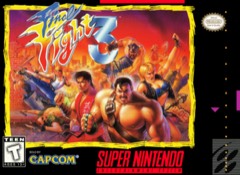
The Mad Gear gang is gone, and a new one, Skull Cross, has taken Metro City. Guy comes back from his training to see his old friend Mayor Haggar just as the gang starts a riot downtown. Two new fighters join them: Lucia, a detective in the police Special Crimes Unit, and Dean, a street fighter whose family Skull Cross murdered.
It is still Final Fight at heart: walk right, clear the crowd, eat the chicken from the drum. But this one moves faster. You can dash, and attack or jump out of a dash, as in Captain Commando. You can grab an enemy from behind, and lock the way you face while you walk. There are Street Fighter style command moves, and a Super Move gauge that fills as you land hits. Spend it on one big attack, and do not sit on it: leave the gauge full too long and it empties itself.
Each fighter has a favourite weapon, Guy's being nunchaku, and picking that one up opens a combo only they can do. Six stages each end in a boss, and the roads fork, so the areas, enemies and bosses you meet change with the path. The ending changes with your fighter, your route and the difficulty.
Where it sits in history
Like Final Fight 2, it came from Capcom's consumer division for the Super NES alone, with no arcade version first. Japan got it as Final Fight Tough on 22 December 1995; North America in December and PAL countries in March 1996. Like its predecessor, you can play alone or with a second player, and it adds a mode where the computer controls your partner.
Critics in 1995 called it more of the same. GamePro liked Lucia, the graphics and the branching stages but found Dean slow and the bosses little more than big thugs. Next Generation said it was not dull, and not all that exciting either. Later writers changed their minds: Complex in 2018 called it the best of the trilogy, and Time Extension in 2023 named it the best Final Fight. Lucia later turned up as a fighter in Street Fighter V.
How it plays today
This is the one to play now. The dash and the grab from behind make crowds something you steer rather than wait out, and the super gauge gives each fight a small decision: spend it now, or save it for the boss and risk losing it. The forked roads mean a second run is not a copy of the first.
The weak spot is the same as always. Stage after stage, the enemies come in the same few shapes, and alone the rhythm turns into work. The computer partner helps more than you would expect; a friend helps more.
Compared with
Why it matters
Final Fight 3 solves the lonely player with a stranger. If no one is on the couch, the game gives you a partner anyway, someone who walks beside you through Metro City and takes some of the punches. It is a small kindness written into a cartridge.
Ryan, Rigby and Przybylski found that games feel good when they meet three needs: competence, choice and connection to others. Most brawlers offer the first. This one adds choice through its roads and its super gauge, and then reaches for the third even when you are alone, because it knows a beat 'em up was always meant to be done side by side.
Read: The second controller →
- Ryan, R. M., Rigby, C. S., & Przybylski, A. (2006). The motivational pull of video games: A self-determination theory approach. Motivation and Emotion, 30(4), 344-360. doi:10.1007/s11031-006-9051-8
What you're levelling up
You have been training these without noticing. Here is how to do it on purpose, and where it pays off away from the couch. All the skills games teach →
Judging risk
In the game. The Super Move gauge fills as you land hits. Sit on it too long and it empties itself, so saving it for the boss is a gamble.
Do it on purpose. Each stage, decide in advance: spend the super on the first big crowd or bank it for the boss. Note which gets you further.
Off the couch. Saving for something big is good. Saving so long the moment passes isn't. Book the trip, ask them out, spend the gauge.
Curiosity
In the game. The roads fork, so the areas, enemies and bosses change with your path, and the ending changes with your fighter, route and difficulty.
Do it on purpose. Play a second run taking every fork you skipped the first time. Write down what was different.
Off the couch. Taking the other road home, the other job offer, the other suburb. Curious people end up with better stories and more mates.
Hand-eye coordination
In the game. You can dash and attack or jump straight out of it, grab enemies from behind and lock which way you face while walking. Crowds become something you steer.
Do it on purpose. Play one stage opening every fight with a dash attack. No panic presses: each one has a reason.
Off the couch. Footy, futsal, getting through a packed bar with three drinks. Moving with control reads as confident.
Verdict · 8/10
Final Fight 3 arrived late and quiet, and it is the best of the three: faster, with choices in every fight and every road. Still a brawler that wants company.