What it was
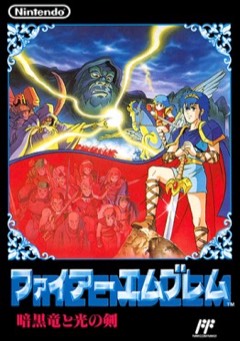
Marth, prince of Altea, loses his father, his castle and the sacred sword Falchion when an ally sells the kingdom out to the Dolhr Empire. His sister Elice gives herself up so he can escape. Years later, from the island of Talys, he sets out with a handful of knights to win it all back, gathering allies across the continent of Archanea until he can face the sorcerer Gharnef and the Shadow Dragon, Medeus.
You fight on grid maps: your whole army moves, then theirs. Every unit has a fixed class. Riders and fliers cover more ground, archers hit from range, armoured knights soak up blows. Each attack cuts to a small battle scene, levels raise stats at random, and weapons wear out and break. The rule everyone remembers is the last one. A unit who falls is gone for good, and if Marth falls, the game ends. There are 52 characters to recruit, and keeping them alive is the real game.
Where it sits in history
Intelligent Systems and Nintendo R&D1 built it, and Nintendo released it on the Famicom in Japan on 20 April 1990. Shouzou Kaga dreamed it up in 1987, after Famicom Wars: that game's strategy, joined to the story and characters of a role-playing game. Keisuke Terasaki directed, Gunpei Yokoi produced and Yuka Tsujiyoko wrote the music. Kaga called it a dōjin project made on a whim, and it outgrew the cartridge: the team borrowed memory set aside for saves and cut the story pictures they had planned.
Japanese magazines found it hard to follow and plain to look at, and sales sat flat for two months. Word of mouth and a Famitsu column turned it round, and by 2002 it had sold 329,087 copies. It launched the series and is credited with making tactical RPGs popular in Japan, with Tactics Ogre and Final Fantasy Tactics among those in its debt. A Nintendo DS remake brought the story West, but the original itself reached English only in December 2020, a Switch release for the 30th anniversary that was sold until the end of March 2021.
How it plays today
The bones are all here, and they still work. Planning a turn, pulling a wounded knight back, baiting an enemy into your archers' range: the loop that carries every later Fire Emblem already satisfies. Permadeath gives every move weight. You play carefully not because the game tells you to, but because you'd like to keep Caeda.
Everything around the bones creaks. The maps look bare, growth is random, so a unit you pour hours into can turn out a dud, and scarce money plus breaking weapons punish experiments. Without the Switch version's rewind, one unlucky turn can cost you a map. Go in knowing it is a first draft, and the first draft of something that mattered.
Compared with
Why it matters
Most games forgive you. This one remembers. Lose a knight on an early map and the knight is missing from every map after, a gap in the roster you notice each time you deploy. Jesper Juul calls it the paradox of failure: we avoid failing in ordinary life, yet seek it out in games, because failing makes us stop, reconsider and improve. Shadow Dragon pushes that close to grief. The loss stays, so the lesson does too.
Kaga wanted players to care about his soldiers the way they care about the hero of a role-playing game, and permadeath is how he got there. Nobody tells you to love a minor archer. You just do, after one survives a bad turn by a sliver. And the game pays the care back at the very end: if Caeda lives, she and Marth declare their love. Turns out caring is mostly paying attention, one turn at a time.
Read: One must imagine Mario happy →
- Juul, J. (2013). The Art of Failure: An Essay on the Pain of Playing Video Games. MIT Press.
What you're levelling up
You have been training these without noticing. Here is how to do it on purpose, and where it pays off away from the couch. All the skills games teach →
Planning ahead
In the game. Your whole army moves, then theirs. Riders and fliers go further, archers hit from range, armoured knights take the blows, so every turn is a plan before anyone steps.
Do it on purpose. Before you end a turn, check what each enemy can reach. Fix the weakest spot first, every time.
Off the couch. Thinking through who gets hit by a decision before you send the email. Saves you a week of cleaning up.
Judging risk
In the game. Fallen units are gone for good, money is scarce and weapons break. You can even bet gold on arena fights. Every attack is a call: push for the kill or pull the wounded back.
Do it on purpose. One map, one rule: never leave a unit where it can't survive the enemy turn.
Off the couch. On a date it's the small calls: suggest the second drink or call it while it's still fun. Leaving on a high beats overstaying, and they'll want to see you again.
Bouncing back
In the game. Lose a knight and the knight is missing from every map after. You carry on short-handed, and the next map plays different.
Do it on purpose. Next time someone falls, don't reset. Finish the map with who you've got and see what you learn.
Off the couch. Some losses stick: the job, the mate who moved away. Getting on with the crew you've still got is the skill.
Verdict · 7/10
The blueprint for a whole genre, and its core still grips: plan the turn, protect your people, live with the losses. Rough, plain and unforgiving, so play it for the history and the tension, not the polish.