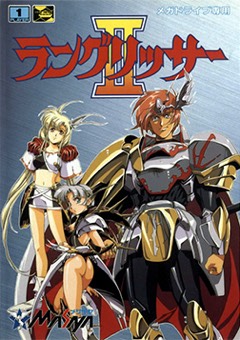
What it was
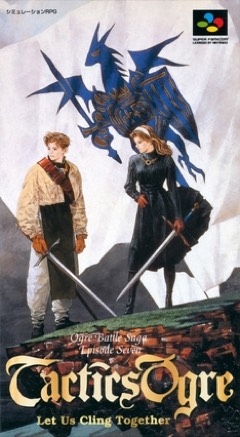
Valeria is an island kingdom whose king has died with no heir, and three peoples are fighting over what's left. You play Denim Powell, a young man in a resistance group of the Walsta, the side that's losing. Early on, your own leader orders the massacre of a town that won't join the cause, so he can blame the enemy. What you do about that decides which of three paths, Law, Neutral or Chaos, the story takes for its first three chapters. Characters live or die by those choices, and there are up to eight endings.
Battles happen on small maps seen from a diagonal angle, laid out as a grid with hills and walls. You field up to ten units from an army of thirty. Turns don't alternate by side: each unit acts when its wait counter runs down, and heavy units wait longer. Magic charges up during a fight before it can be cast. Denim can also try to persuade enemy units to change sides. If he dies, the game is over.
Where it sits in history
Quest Corporation developed and published it in Japan on 6 October 1995, after the surprise success of Ogre Battle: The March of the Black Queen. Yasumi Matsuno directed, designed and wrote it with a team of about fifteen over two and a half years. Hiroshi Minagawa was art director, Akihiko Yoshida drew the characters, and Hitoshi Sakimoto and Masaharu Iwata wrote the music. Matsuno drew on real wars, including the Yugoslav Wars and the Rwandan genocide, and took the subtitle from a Queen song.
It sold over 500,000 copies in Japan. Famitsu readers voted it seventh in their all-time favourites in 2006. The Super Famicom version never came out in English; the West first got it on PlayStation in 1998 through Atlus. Matsuno left Quest after finishing it, joined Square with several of its staff and made Final Fantasy Tactics. Minagawa brought most of the team back for a PSP remake in 2010, and Tactics Ogre: Reborn, based on that remake, followed in November 2022.
How it plays today
Few strategy games before or since have written war this seriously. The story is political, the choices hurt, and the battles reward patience and clever positioning more than brute force.
It's also hard. Some of Famitsu's reviewers said the difficulty made the training mode close to compulsory, and the original is in Japanese. For most players Reborn is the way in.
Compared with
Why it matters
The massacre is the hinge of the game, and the question that follows isn't only who did it but who gets blamed. Your leader plans to pin it on the other side, and whether that story sticks depends partly on you.
Howard Becker wrote that 'deviant behavior is behavior that people so label': what counts as a crime depends on who makes the rules and who they apply them to. Tactics Ogre turns that into a playable choice. Matsuno wrote it to show how a conflict between any two groups could be resolved, and the game hands that question to you.
Read: The magic circle: the world that rules make →
- Becker, H. S. (1963). Outsiders: Studies in the Sociology of Deviance.
What you're levelling up
You have been training these without noticing. Here is how to do it on purpose, and where it pays off away from the couch. All the skills games teach →
Planning ahead
In the game. Ten units from an army of thirty, a grid of hills and walls, magic that charges before it casts, and if Denim dies, it's over.
Do it on purpose. Before your next battle, write down where Denim stands for the first three turns and why. Compare it with what actually happened.
Off the couch. Planning a move, a career change or a holiday works the same: decide the first three steps and know what you're protecting. Good plans leave room to bend.
Story sense
In the game. Your own leader orders a town massacred so he can blame the enemy, and what you do about it sends the story down Law, Neutral or Chaos.
Do it on purpose. At the next big choice, argue each side out loud for a minute before you pick. Then pick the one you'd defend to a mate.
Off the couch. Seeing why someone did the thing you hate is the difference between an argument and a conversation. Matters at work, and heaps in a relationship.
Systems thinking
In the game. Turns don't alternate by side. Each unit acts when its wait counter runs down, and heavy units wait longer, so armour costs you time.
Do it on purpose. Fight one battle with mostly light units and one with mostly heavy. Note how many turns you get and what changes.
Off the couch. Everything has a trade-off: a bigger car, a bigger rent, a longer commute. Seeing what each choice costs somewhere else makes you better with money.
Verdict · 9/10
One of the best strategy games ever made and one of the bravest stories of its time. Play Reborn if the original is out of reach.