What it was
It's 2090, and Huffman Island in the Pacific is split between two superpowers. Royd Clive leads a scouting team into an enemy factory, gets ambushed, and watches his fiancée Karen's machine destroyed before the factory blows up. The USN, whose officer set the ambush, sells it to the world as an enemy attack, a second war begins, and Royd and his team are discharged and listed as killed in action. A year later he is fighting for money in an arena when a mercenary outfit, the Canyon Crows, offers him a way back in.
The war is fought in wanzers, short for the German Wanderpanzer, or walking tank. Each wanzer has four parts, a body, two arms and legs, and every part has its own health. Lose the body and the machine is gone. Lose an arm and you lose that arm's weapon; lose the legs and you crawl one square at a time. Between missions you build each wanzer from parts, computers, backpacks and weapons, inside a weight limit set by its power output. Weapons come in four kinds, from melee to support fire that can never be answered but runs out of ammunition.
Where it sits in history
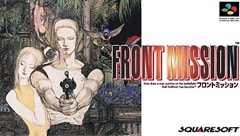
G-Craft developed it and Square published it in Japan in February 1995, the first time Square had let another studio make a game for it. Toshiro Tsuchida pitched the idea; Square kept telling him no robots, so he built a prototype, and Square agreed in the end, partly because it had mostly made fantasy games until then. Producer Shinji Hashimoto asked for lighter moments, such as the cast playing cards, to balance a story he saw as dark. Noriko Matsueda and Yoko Shimomura wrote the music. Kow Yokoyama helped design the wanzers so they looked like real weapons.
The Super Famicom original never left Japan. A WonderSwan Color port followed in 2002, and a PlayStation remake, Front Mission 1st, added a second campaign from the other side of the war in 2003. That remake reached North America on the Nintendo DS in October 2007, simply called Front Mission. A further remake, Front Mission 1st: Remake, came to Switch in November 2022 and to PlayStation, Xbox and Windows in June 2023.
How it plays today
The wanzer system is still the best reason to play. Aiming for legs to slow a dangerous machine, or for arms to disarm it, makes every fight a set of small choices, and building a squad from parts is absorbing in its own right.
The original's text is Japanese only, and the missions are slow by today's standards. Most people should start with the 2022 remake, which carries both campaigns.
Compared with
Why it matters
Front Mission is about people being turned into parts. Its machines come apart arm by arm, and its plot reveals, slowly, that someone has been doing the same to soldiers. Against that, Hashimoto made room for the Crows to sit around and play cards.
Goffman wrote that a game builds a small world with its own rules about what matters, and that being absorbed in it together is what makes a gathering feel alive. The card games are that idea in miniature, a game inside a war game, and they are why the Crows read as people rather than pilots. When the squad splits late on, it hurts because you saw them at the table.
Read: The second controller →
- Goffman, E. (1961). Encounters: Two Studies in the Sociology of Interaction ('Fun in Games').
What you're levelling up
You have been training these without noticing. Here is how to do it on purpose, and where it pays off away from the couch. All the skills games teach →
Systems thinking
In the game. Each wanzer is a body, two arms and legs, kitted out with parts, computers, backpacks and weapons inside a weight limit set by its power output. Change one piece and the rest shift.
Do it on purpose. Rebuild one wanzer changing a single part, then take it into a mission and note what else moved: speed, hits, ammo.
Off the couch. Budgets work the same. A bigger car means more rego, more fuel and less for the trip. See the knock-ons before you buy.
Problem solving
In the game. Every part has its own health. Shoot the legs and a dangerous machine crawls one square at a time; shoot an arm and its weapon goes with it.
Do it on purpose. Each mission, pick the most dangerous enemy and decide which part to break first, and why. Check afterwards whether it worked.
Off the couch. Big problems at work break into parts too. Find the bit that takes the danger out and fix that first.
Teamwork
In the game. Between missions the Canyon Crows sit around playing cards. That's why they read as people, not pilots, and why it hurts when the squad splits late on.
Do it on purpose. Give every pilot a role, front line, support fire or close work, and build their wanzer for it. Notice which missions fall apart when someone leaves their post.
Off the couch. The beers after the shift are what turn workmates into mates. Turn up to them.
Verdict · 8/10
A grown-up war story with a combat system built on losing one limb at a time. Play it through the remake if you can.