What it was
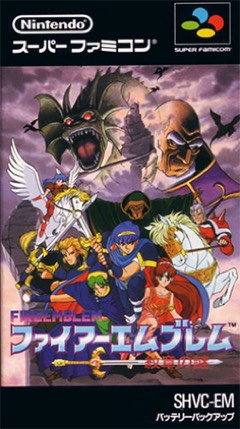
Two games on one cartridge. Book 1 retells the first Fire Emblem: Marth, prince of Altea, driven into exile, gathers an army to defeat the dark dragon Medeus and the sorcerer Gharnef. Book 2 is new, and darker. Marth's old ally Hardin takes the throne of Archanea and turns to conquest, and Marth has to march against a friend.
It plays as a turn-based tactics game on grid maps. You move units one at a time, then the enemy moves, and each battle is shown on its own screen. Classes decide how far a unit moves and what it can wield; each unit carries four weapons and four items. Mounted knights can dismount, trading reach for different stats. A Support system rewards pairing characters with a story bond, such as friends or lovers, with better accuracy or dodging when they fight near each other.
Where it sits in history
Intelligent Systems began work in 1992 while still making Fire Emblem Gaiden, and production took almost three years. Series creator Shouzou Kaga designed and wrote it, Keisuke Terasaki directed, Gunpei Yokoi produced and Yuka Tsujiyoko composed the music; she later called it her favourite of the Fire Emblem games she worked on. The team planned a remake and a sequel as separate projects before merging them, and cut some characters from Book 1 to fit.
Nintendo released it on the Super Famicom on 21 January 1994, the series' first game on the console and its first on a 24-megabit cartridge. It stepped back from Gaiden's experiments to the first game's style and was made easier to draw in new players. It sold 776,338 copies by 2002, the series' best at the time. It never came out in the West; a Nintendo DS remake, New Mystery of the Emblem, followed in Japan in 2010.
How it plays today
The core holds up. Maps are clear, the rules are simple, and each battle is a small puzzle about who moves where and in what order. Book 2 is the stronger half, with a story that actually hurts and maps that ask more of you. The music, especially later on, is excellent.
It feels early next to later Fire Emblem games. The graphics are plain for the Super Famicom, the menus are slow, and the first half is short on music. Some of the best content in Book 2 is gated behind collecting spheres, and missing them cuts the story short. It came out only in Japanese, so most Western players will rely on a fan translation. For series fans it is a fascinating step; newcomers have gentler starting points.
Compared with
Why it matters
Mystery of the Emblem rewards you for keeping friends close. Its Support system gives characters with a story bond, friends or lovers, better accuracy or dodging when they fight near each other. Then Book 2 asks the harder question: what happens when a friend becomes the enemy? Marth marches against Hardin, an old ally.
Richard Ryan, Scott Rigby and Andrew Przybylski found games satisfy needs for competence, autonomy and relatedness, and that this predicts enjoyment and wanting to play again. Fire Emblem turns relatedness into something you can see on the map. Units standing together fight better, so you start planning around who stands next to whom. By the time Hardin turns, the bond was real enough to plan around, so the break hurts. That's close to how it works off the screen too. We're stronger next to the people we trust, and a betrayal stings in proportion to how much we leaned on them. A tactics game about armies ends up being about keeping your people near.
Read: The second controller →
- Ryan, R. M., Rigby, C. S., & Przybylski, A. (2006). The motivational pull of video games: A self-determination theory approach. Motivation and Emotion, 30(4), 344-360. doi:10.1007/s11031-006-9051-8
What you're levelling up
You have been training these without noticing. Here is how to do it on purpose, and where it pays off away from the couch. All the skills games teach →
Planning ahead
In the game. Each battle is a small puzzle about who moves where and in what order. Move one unit wrong and the enemy phase makes you pay.
Do it on purpose. Before ending each turn, say what the enemy will do next. Play one map without restarting and live with your plan.
Off the couch. Planning the week: gym, work, a catch-up with your mates, a night with your partner. Think a turn ahead and nobody gets dropped.
Teamwork
In the game. The Support system gives characters with a story bond, friends or lovers, better accuracy or dodging when they fight near each other.
Do it on purpose. Pick two paired units and keep them side by side for a whole map. Watch how much more they hit and dodge.
Off the couch. Couples who back each other, at a party, with the in-laws, on a bad day, both do better. Be the one who stands next to them.
Story sense
In the game. Book 2 has Marth marching against Hardin, an old ally turned conqueror. It's a story that actually hurts.
Do it on purpose. Before Hardin turns, work out from his side why he might. Then read every line and see how close you were.
Off the couch. Mates fall out. Seeing it from his side doesn't make him right, but it's how you end up talking again instead of never.
Verdict · 8/10
A solid, handsome tactics game and the best way to see where Fire Emblem's story roots lie. Book 2 alone is worth the effort of getting past the language barrier.