What it was
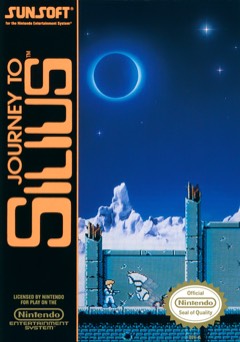
In the year 373 of a new space age, Earth is crowded and people are moving out to colonies. Jay McCray's father is building colony 428 in the Silius Solar System when terrorists blow it up with the whole research team aboard. Jay finds a floppy disk at home with the colony plans and a message from his father: if the terrorists win, finish the job. Jay sets out to protect the plans and find the people who killed his father.
Five stages take you through a ruined colony, an underground concourse, the enemy hideout, a flying ship and a factory, each with a boss at the end. You can only shoot left or right. Alongside the default handgun you collect a shotgun, a machine gun, a homing gun, a laser rifle and a grenade launcher, all drawing on one gun-energy gauge. Run it dry and you are back to the pistol. Finish the fifth stage and the game starts over from the first.
Where it sits in history
Sunsoft made and published it in 1990. It started as a game of the 1984 film The Terminator, but Sunsoft lost the licence during development and changed the story and graphics to suit. In Japan it is Rough World, and there and in Europe Jay wears a full suit of armour; in the American version his face shows.
Naoki Kodaka wrote the music, and did something unusual with it. NES composers normally used the console's sample channel for drums. Kodaka, with programmers Nobuyuki Hara, Shinichi Seya and Naohisa Morota, used it for a sampled bass line and played the kick drum on the triangle channel. The game itself was never a big hit in the West. The soundtrack has been praised ever since. Japan got it again on PlayStation in Memorial Series: Sunsoft Vol. 5, paired with Hebereke, and Nintendo added it to its online service on Switch in December 2019.
How it plays today
Turn it up. The sampled bass hits harder than anything the NES is supposed to manage, and the music carries you through stages that are otherwise grey corridors of robots.
The game around the music is hard and a bit stiff. Shooting only left and right feels like a handicap, and the weapons you collect don't last. It is short, though, and the shared gauge rewards saving the good guns for the bosses.
Compared with
- Contra: Konami's NES run-and-gun, the one every game like Silius gets measured against.
- Blaster Master: Sunsoft's best-known NES action game, from two years earlier.
- The Terminator: The licence went elsewhere: this NES Terminator game came out in 1992.
Why it matters
Wildschut and colleagues found that nostalgia is mostly a warm feeling, and that it leaves us more connected to other people. Journey to Silius is a case where the memory outlasted the thing. Its levels never won wide acclaim. Its music has been praised for decades.
That is how nostalgia often works with games. We don't remember the whole experience, we remember the part that moved us, and for many players that part was a bass line squeezed out of a channel never meant to play one.
Read: Why old games feel like home →
- Wildschut, T., Sedikides, C., Arndt, J., & Routledge, C. (2006). Nostalgia: Content, triggers, functions. Journal of Personality and Social Psychology, 91(5), 975-993. doi:10.1037/0022-3514.91.5.975
What you're levelling up
You have been training these without noticing. Here is how to do it on purpose, and where it pays off away from the couch. All the skills games teach →
Judging risk
In the game. Every gun you collect draws on one gun-energy gauge. Run it dry and you're back to the pistol, so firing the good stuff early is a bet.
Do it on purpose. Play a stage on the handgun alone until the boss, then unload. Compare with a run where you spend freely.
Off the couch. Payday works the same way: blow it all in the first week, or keep some back for the rent, the bills and the date at the end of the month.
Bouncing back
In the game. You can only shoot left or right and the bosses hit hard, so each one takes a few deaths to learn.
Do it on purpose. Count your continues to the end of stage two. Next session, beat that number, and name one fix after each death.
Off the couch. A flat first date isn't a verdict on you. Work out what was off, keep the good bits and go again.
Deep focus
In the game. Long grey corridors of robots, and a bass line that keeps you locked in through every one.
Do it on purpose. Headphones on, phone away, one stage over and over. Notice when the music pulls you in and your play tightens up.
Off the couch. Find the music that puts you in the zone and save it for study or the gym. Same trick, different boss.
Verdict · 7/10
A tough, plain shooter with a soundtrack that sounds like the NES has been taken apart and rewired. Play it for the ears.