What it was
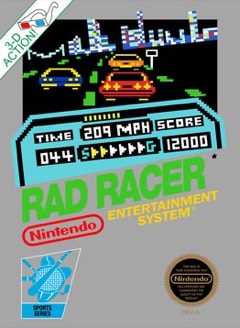
A race across America, west coast to east, in eight stages. You pick a Ferrari 328 or a Formula One car before the start, and it makes no difference: both drive the same. Hold the accelerator to 100 km/h, then kick in the turbo and watch the needle climb to 255. Traffic thickens as you go, from Beetles to Testarossas, and a clipped bumper flips you end over end.
Every stretch is a race against the clock to the next chequered flag. When time runs out the car does not stop dead; it coasts, slowing for a few seconds, so you can sometimes roll over the line on fumes. Press Select and the picture splits into red and blue for anaglyph 3D glasses. You can even change the music while you drive.
Where it sits in history
Square's president, Masafumi Miyamoto, wanted a game that would show off the 3D programming Nasir Gebelli had brought from the Apple II. Gebelli had just made The 3-D Battles of WorldRunner for Square, and two programmers had left as he arrived, so he started Rad Racer alone. To make the road bend on a cathode-ray television, the team scrolled the picture one scanline at a time. Kazuko Shibuya, who drew the sprites, would tell Gebelli how many pixels and which colour each line of road needed, and he would go and build it. Takashi Tokita programmed the billboards and made the levels, and it was Akitoshi Kawazu's first game at Square.
It came out in Japan as Highway Star on 7 August 1987, in North America that October and in Europe in January 1988. It sold 1.96 million copies. It turned up in the film The Wizard and was one of three games at the 1990 Nintendo World Championship. Square was still in financial trouble despite those sales, and its next big swing was Final Fantasy.
How it plays today
Faster than you expect. Reviewers have always said it borrows a lot from Out Run, and they are right, but the speed is its own. At full turbo the stripes rush at you and the corners arrive sooner than you can read them, and that pressure is the whole game.
The cracks are the collision, which reviewers have long faulted, and the sameness: eight stages of the same loop of brake, turbo and swerve wear thin. The 3D mode is a curiosity rather than a reason to play. Fifteen minutes of it is a joy; an hour is plenty.
Compared with
- The 3-D Battles of WorldRunner: Gebelli's first 3D game for Square, made for the same glasses.
- Rad Racer II: The North America-only sequel: eight new tracks, new music, the same idea.
- F-Zero: The SNES answer to the same itch, faster and far more varied.
- Final Fantasy: The game Square made next, its last try for a breakout hit.
Why it matters
Roger Caillois named a kind of play ilinx: the pleasure of vertigo, of spinning until the world tilts. Children do it on swings. Rad Racer does it with a few lines of colour and a turbo button. Nothing in it is real, not the Ferrari, not the road, yet at 255 km/h your shoulders lean into the corners anyway.
That is what Gebelli and Shibuya were building, one scanline at a time: not a car, but the feeling of going too fast.
Read: The magic circle: the world that rules make →
- Caillois, R. (1958/1961). Man, Play and Games (trans. M. Barash).
What you're levelling up
You have been training these without noticing. Here is how to do it on purpose, and where it pays off away from the couch. All the skills games teach →
Judging risk
In the game. At full turbo the corners arrive sooner than you can read them, and one clipped bumper flips you end over end. Push or back off, every second.
Do it on purpose. Run a stage and only drop the turbo on corners you know. Count crashes, then see if your time actually got worse.
Off the couch. Driving is the obvious one. Also knowing when to push at work and when easing off gets you there in one piece.
Keeping your cool
In the game. Traffic thickens from Beetles to Testarossas and the clock's always ticking. When time runs out you coast, and the calm driver can still roll over the line on fumes.
Do it on purpose. When the timer's low, don't wrestle the wheel. Hold your line and see how far you coast.
Off the couch. Late for the airport, running behind on a deadline. Flapping doesn't make you faster. Steady does.
Deep focus
In the game. The stripes rush at you and the pressure is the whole game. Fifteen minutes of it is pure tunnel vision.
Do it on purpose. Play one full run phone face down, nothing else on. Notice the moment you're fully locked in.
Off the couch. Being fully present with someone, not half checking your phone, is rarer than it should be. They'll notice.
Verdict · 6/10
A pure, short hit of speed from a programmer who drew roads line by line. Worth a few runs for the rush, less for the long haul.