What it was
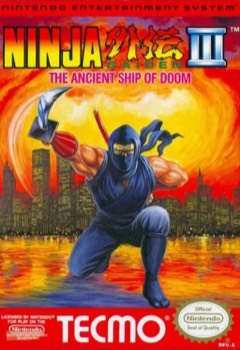
Ryu Hayabusa is framed for the murder of CIA agent Irene Lew and sets out to clear his name. The trail leads to Castle Rock, to an agent named Foster building energy-fed superhumans called bio-noids, and to a stranger called Clancy with plans of his own. The first four bosses are bio-noids, one for each element: earth, wind, fire and water.
The bones are the same as before. Ryu runs, jumps, climbs walls and springs off them, slashing crystal balls for medicine, ninja power and secondary arts. The new parts: he can hang from pipes and ivy overhead, a Vacuum Wave Art throws blades above and below him, and a Dragon Spirit Sword power-up lengthens his reach. The story is set between the first two games, not after them.
Where it sits in history
Tecmo developed and published it. Masato Kato designed it, taking over from Hideo Yoshizawa, who had led the first two, and pushed it towards science fiction: the enemies look robotic now. The Famicom version came out in Japan in June 1991 as Ninja Ryūkenden III, the NES in North America in August. Europe never got the NES game.
The team set out to make a game a normal player could enjoy. Then the North American release doubled the damage of every hit, capped continues at five and dropped the Japanese password system. Nintendo Power gave it its Best Challenge award for 1991. Later critics at IGN and Nintendo Life called the difficulty cheap and the level design uneven.
It went to the Atari Lynx in 1993 and onto the Ninja Gaiden Trilogy compilation for the Super NES in 1995. The Wii Virtual Console had it in 2008, the 3DS in 2013, and in 2026 it came to Nintendo Classics and to Hamster's Console Archives on Switch 2 and PlayStation 5.
How it plays today
Moment to moment it is the slickest of the three. Hanging from a pipe and dropping onto an enemy is a lovely new verb, and the longer sword makes Ryu feel strong.
The American version is the problem. Two bars of health per hit turns small mistakes into deaths, and five continues for the whole game means a bad evening sends you back to Act 1. If you can play it with the Japanese damage, do; it is closer to the game Kato meant to make.
Compared with
Why it matters
Bernard Suits defined playing a game as 'the voluntary attempt to overcome unnecessary obstacles'. Ninja Gaiden III shows how fine that line is. The same game, with one number changed, went from something its designers hoped anyone could finish to something Nintendo Power gave an award for being hard.
Every obstacle in a game is unnecessary. What makes it a game and not a chore is that we agreed to it. Most players never knew the deal had been changed for them.
Read: The magic circle: the world that rules make →
- Suits, B. (1978). The Grasshopper: Games, Life and Utopia.
What you're levelling up
You have been training these without noticing. Here is how to do it on purpose, and where it pays off away from the couch. All the skills games teach →
Judging risk
In the game. In the American version two bars of health go per hit and you get five continues for the whole game. A bad evening sends you back to Act 1.
Do it on purpose. Before each tricky section, decide whether to push or play slow and safe. Track how many continues each choice costs you.
Off the couch. When there's no do-over, slow down. Signing a lease, sending the big email, buying a car.
Hand-eye coordination
In the game. Hanging from a pipe and dropping onto an enemy is a lovely new move, and the Dragon Spirit Sword lengthens your reach.
Do it on purpose. Find a stretch with overhead pipes and practise the drop-and-slash until it's clean five times running.
Off the couch. Getting good with your hands at anything, a tool, a ball, a guitar, builds the kind of quiet confidence people notice straight away.
Keeping your cool
In the game. Small mistakes turn into deaths fast. The players who get through stay steady instead of flinching.
Do it on purpose. When you lose a life, put the controller down for ten seconds before going again. Notice if your next run's cleaner.
Off the couch. A short pause before reacting saves you in arguments, at work and in traffic. The calm one usually wins.
Verdict · 7/10
The best-feeling Ryu on the NES, buried under an American difficulty spike nobody designed it for. Worth it if you have the patience.