What it was
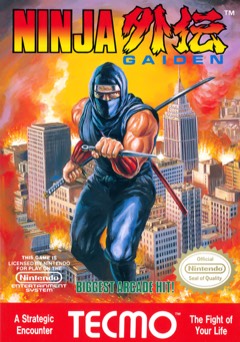
Ryu Hayabusa finds a letter from his father, who seems to have died in a duel, and follows it to America, into a plot about two demon statues, a CIA agent, and a sorcerer called the Jaquio. The story unfolds in six Acts over 20 levels, and between them come animated scenes: big anime art in the top half of the screen, dialogue underneath, framed with close-ups and cuts like a comic come to life.
In play it is a fast side-scrolling action platformer. Ryu slashes with the Dragon Sword, spends spiritual strength on thrown stars, fire wheels and a spinning jump slash, and can cling to walls and spring between them. He can't attack while clinging, which the level design never lets you forget.
Where it sits in history
Tecmo made it alongside an arcade game of the same name, but the two are separate projects by separate teams: the arcade game is a beat 'em up, this is a platformer. Hideo Yoshizawa directed and wrote the NES version and built more than 20 minutes of cutscenes into it, drawing on his old wish to make films. Masato Kato, on his first full project, handled graphics and animation, and Keiji Yamagishi wrote the music.
It came out in Japan in December 1988 as Ninja Ryūkenden, in North America in March 1989, and in Europe in August 1991 as Shadow Warriors. It did moderately at home and far better in America, where Nintendo Power pushed it hard, and it passed 1.8 million cartridges worldwide. Two NES sequels followed. Tecmo's stated view at the time, that a game too easy gets thrown away, explains the rest.
How it plays today
The movement is superb. Ryu animates on very few frames, which makes him snap between actions, and the wall-jump gives stages a vertical rhythm few NES games had. The music is quick and driving, and the cutscenes still carry the story with real style.
The difficulty is where opinions split. Birds and bats swoop in at the exact moment you jump, knocking you into pits, and enemies reappear the instant you scroll back a step. Act 6 is infamous: lose to any of the last three bosses and you go back to the start of the Act. Unlimited continues soften it, but the ending is a genuine test of nerve. A version with save states makes it far more approachable without gutting the thrill.
Compared with
- Castlevania: The obvious model: same sub-weapon idea, but Ryu is quick and agile where Simon Belmont is slow and deliberate.
- Mega Man 3: Both are fast, hard NES action games; Mega Man lets you pick your route, Ninja Gaiden drags you down one corridor.
- Teenage Mutant Ninja Turtles: Another hard NES ninja game from 1989, but far less fair about it.
Why it matters
Everyone who played Ninja Gaiden has a bird story. You line up a jump, a bird swoops in the moment you leave the ground, and Ryu drops into a pit. You swear, and you go again. Act 6 is worse: lose to any of the last three bosses and the whole Act starts over. Tecmo believed a game too easy gets thrown away, and built accordingly.
Albert Camus ended his essay on Sisyphus, the king condemned to roll a rock uphill forever, with a line: 'One must imagine Sisyphus happy.' The meaning sits in the struggle itself, not the summit. Anyone who finally beat the Jaquio knows the feeling. Isabela Granic and colleagues, reviewing the evidence on play, list persistence after failure among its benefits. Ninja Gaiden did not invent persistence, but it tested a lot of players for it, and a surprising number passed.
Read: One must imagine Mario happy →
- Camus, A. (1942). The Myth of Sisyphus.
- Granic, I., Lobel, A., & Engels, R. C. M. E. (2014). The benefits of playing video games. American Psychologist, 69(1), 66-78. doi:10.1037/a0034857
What you're levelling up
You have been training these without noticing. Here is how to do it on purpose, and where it pays off away from the couch. All the skills games teach →
Memory and routing
In the game. Birds and bats swoop in at the exact moment you jump, and enemies reappear the instant you scroll back. You learn each screen by heart.
Do it on purpose. Pick one level and say out loud where each bird comes from before it arrives. Then do it without talking.
Off the couch. Knowing the ground before you walk it, a new job's systems, an exam's format, takes the panic out of it.
Bouncing back
In the game. Act 6 is infamous: lose to any of the last three bosses and you go back to the start of the Act. The ending is a test of nerve.
Do it on purpose. Treat each trip back through Act 6 as practice for one specific boss. Name the move that killed you and plan around it.
Off the couch. Getting knocked back to square one is part of anything worth doing. Whoever goes again calmly is the one who gets there, and that resilience is attractive.
Story sense
In the game. Between Acts, big anime scenes tell the story of Ryu's father, the demon statues and the Jaquio, framed like a comic come to life.
Do it on purpose. Watch every cutscene properly instead of skipping. Before each Act, guess where the story's going.
Off the couch. Following a story and guessing where it goes makes you good at films, books and reading where a conversation's heading.
Verdict · 9/10
Stylish, quick and still thrilling to control, with a story that set a new bar for the NES. The last Act is hard enough to be part of its legend.