What it was
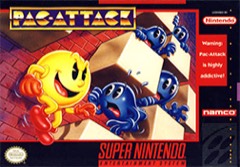
Pac-Attack is a falling-block puzzle game from Namco. Pieces made of blocks and ghosts drop into a tall playfield. A full horizontal row of blocks clears. Ghosts only clear when you drop a Pac-Man piece, which eats any ghosts in its path and then vanishes if it gets stuck with nothing left to eat.
Eating ghosts fills a fairy meter on the left. When it's full, a fairy piece arrives that clears every ghost below it, so you can set up chain reactions. There's a single-player mode, a two-player mode and a Puzzle Mode with 100 levels where you clear each ghost in as few moves as possible, with a password for each level.
Where it sits in history
It's an adaptation of Cosmo Gang the Puzzle, a 1992 Namco arcade game that also came out on the Super Famicom in Japan. Pac-Attack came out for the SNES in North America in October 1993, and some European and Japanese releases were called Pac-Panic. It was the first Pac-Man game released exclusively for home platforms.
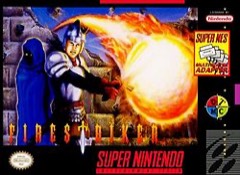
Hiromi Shibano wrote the music and Greg Martin did the cover. To promote it, Namco ran a GameFan magazine contest with cash prizes for high scores. The grand prize was a $500 gift certificate. The SNES version sits at 66% on GameRankings.
How it plays today
The idea is clever. Ghosts are the thing you can't clear by lining up rows, so you plan around where Pac-Man will walk. Which way he faces tells you which way he'll go, and the best moments come when one piece clears a whole tangle.
It runs out of road fast. Critics at the time said it wasn't as good as Tetris or Dr. Mario, and Hardcore Gaming 101 thought only Puzzle Mode had lasting appeal. Play Puzzle Mode solo and the versus mode with a mate.
Compared with
- Tetris: The one every falling-block game gets compared with.
- Columns: Another early falling-tile puzzler.
- Tetris Attack: A later puzzler that did the versus mode with more depth.
Why it matters
Caillois sorted play into kinds, and one is agon, competition. Pac-Attack's two-player mode is agon in a few lines: clear pieces, and extra ones fall on your opponent's side. No story. Just whose pile reaches the top first.
There's something honest about that. A tiny set of rules, a mate beside you, and ten minutes of friendly rivalry that you can finish before dinner.
Read: The magic circle: the world that rules make →
- Caillois, R. (1958/1961). Man, Play and Games (trans. M. Barash).
What you're levelling up
You have been training these without noticing. Here is how to do it on purpose, and where it pays off away from the couch. All the skills games teach →
Pattern recognition
In the game. You read which ghosts sit where, and where a Pac-Man piece will walk, to clear several at once.
Do it on purpose. Before each drop, spot the one placement that clears the most ghosts.
Off the couch. Seeing the cluster in a spreadsheet, or noticing a mate goes quiet every time work comes up, and asking about it.
Planning ahead
In the game. Puzzle Mode has 100 levels where you clear each ghost in as few moves as possible.
Do it on purpose. Plan the whole level on paper before moving.
Off the couch. Putting a Saturday's errands in the right order, so you're not driving past the same servo three times.
Winning and losing well
In the game. In versus play, clearing pieces drops extras onto your opponent, so a loss often comes from their good chain.
Do it on purpose. Win or lose, name one thing the other player did well.
Off the couch. Handing over the last chip and meaning it. Good company wins more dates than good scores.
Verdict · 6/10
A good idea that doesn't quite hold. Worth a look for the Pac-Man twist and Puzzle Mode.