What it was
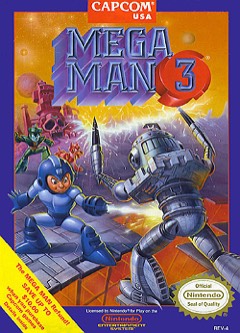
Dr. Wily says he has gone straight and is helping Dr. Light build a peacekeeping robot called Gamma. Then eight Robot Masters on mining worlds run off with Gamma's power crystals. You pick their stages in any order, beat each boss, take its weapon, and use the right weapon on the right boss to make the next fight easier.
Three additions changed the series for good. Mega Man can now slide under shots and low gaps. His robot dog Rush becomes a spring, a jet and a submarine. And a masked rival called Break Man keeps turning up to fight you before the ending tells you who he is. After the eight bosses, four stages come back in harder form, with Doc Robots copying the Mega Man 2 bosses, before Wily's fortress.
Where it sits in history
Capcom released it in Japan on 28 September 1990, in North America later that year and in Europe, through Nintendo, in 1992. It followed Mega Man 2, a hit, and sold over a million copies.
Behind the scenes it was a hard project. Akira Kitamura, who led the first two games, had left Capcom. The main planner dropped off too, so artist Keiji Inafune took on the job and spent the final two months splitting tasks among a team behind schedule. Capcom shipped in September rather than the usual December, and Inafune has since named it one of his least favourite entries, saying more time would have made it better. Composer Harumi Fujita wrote a few tracks before going on leave, and Yasuaki Fujita wrote most of the rest. Fans sent in around 50,000 boss ideas; eight made it.
How it plays today
Very well, mostly. The slide makes Mega Man feel quicker and more modern than in the first two games, and Rush Jet in particular opens up levels in a way the series had not managed before. The music is strong, the stages are varied, and it is longer than any other NES Mega Man, which makes it good value.
The rush shows in places. Sprite flicker kicks in when the screen gets busy, a few of the new weapons feel less useful than Mega Man 2's best, and the Doc Robot stages feel like padding if you only wanted eight bosses and a castle. It is also hard: jumps need precision and some rooms punish any hesitation. A password system lets you skip replays of beaten stages, which helps.
Compared with
- Mega Man: The original set the pattern; Mega Man 3 keeps it and adds the slide, Rush and far more stages.
- Mega Man X: The SNES reboot takes the slide idea further with a dash and wall climbing, and it moves faster and freer.
- Ninja Gaiden: Both are fast, hard NES action games; Ninja Gaiden is stricter and more cinematic, Mega Man 3 more playful.
Why it matters
Around 50,000 boss ideas reached Capcom from fans, and eight made it into Mega Man 3. Picture the people behind them, inventing robots, weak points and all, and posting them off to a game company. That is play doing what it has always done. Lev Vygotsky, the Soviet psychologist, saw that in play a child stands a head taller than they are: play stretches people just past what they can do. Someone drawing a boss is not pretending to design games. For an afternoon, they do.
The game itself came out of the same kind of stretch. With the planner gone, Keiji Inafune, until then an artist, found himself running a team behind schedule, and has said since that more time would have made it better. Mega Man 3 is what happens when a lot of people reach just past their grasp at once, fans included. The seams show. So does the reach.
Read: Older than us: play before people →
- Vygotsky, L. S. (1978). Mind in Society: The Development of Higher Psychological Processes.
What you're levelling up
You have been training these without noticing. Here is how to do it on purpose, and where it pays off away from the couch. All the skills games teach →
Hand-eye coordination
In the game. The new slide lets Mega Man duck under shots and low gaps. Jumps need precision and some rooms punish any hesitation.
Do it on purpose. Pick one tricky room and slide through it ten times clean. Focus on starting the slide a fraction earlier each go.
Off the couch. Quick, sure hands show up in sport, driving and catching the glass your mate knocks off the bar. People trust someone who moves with confidence.
Curiosity
In the game. Rush becomes a spring, a jet and a submarine, and Rush Jet opens up levels in a way the series hadn't before.
Do it on purpose. Replay a stage you've beaten and try to reach somewhere odd with Rush Jet. See what's tucked up there.
Off the couch. The one who asks 'what if we went the other way' finds the good pub, the shortcut, the better idea. And makes a better date.
Bouncing back
In the game. Four Doc Robot stages come back harder after the eight bosses, right when you think you're nearly done.
Do it on purpose. When a Doc Robot stage beats you, play it once just to learn the room that killed you. Then go for a clean run.
Off the couch. There's always another level after the one you thought was the last. Uni finals, a second job interview. Regroup and go.
Verdict · 9/10
The most generous of the NES Mega Man games, even with the seams showing. Play it after Mega Man 2 and enjoy how much it adds.