What it was
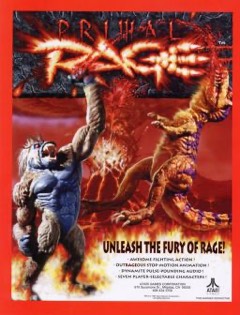
A fighting game where the fighters are dinosaurs and apes who are also gods. The arcade original came out in 1994 from Atari Games, set on a wrecked future Earth called Urth, and gave you seven beasts to pick from: Blizzard, Armadon, Talon, Sauron, Chaos, Vertigo and Diablo. Each has its own three attacks, its own arena and its own domain, from the god of good to the god of decay.
The odd bit is the crowd. Tiny human tribesmen wander the edges of every fight, worshipping you, and you can pick them up and eat them to top up your health. Eating the other player's followers scores you a bonus. Eating your own costs you points. Before the final fight in single-player, a minigame lets you scoff as many as you can to fatten the health bar for the endurance round against everyone else.
Where it sits in history
Time Warner Interactive published it in arcades in August 1994, in a standard cabinet and a bigger deluxe one. It was a hit: RePlay ranked it the third most popular deluxe arcade game of the time. More than 1.5 million copies were sold across all versions, although Atari Games made more profit from the merchandise than the game itself: toys, comics and a novel.
The Super Nintendo port was made by Bitmasters and came out on 25 August 1995 in both North America and Europe, the same day as the Game Boy version. It looks more detailed than the Genesis release, and it censors Chaos's notorious urination fatality. Time Warner pushed the home versions with a Primal Rage tournament at Six Flags Over Texas in October 1995. The Genesis release is the one that got the headlines the next year, when a mother in Arizona started a campaign against it and Best Buy pulled it from 251 stores. The ESRB looked again and kept it at T for Teen.
How it plays today
Reviewers weren't kind. GamePro was lukewarm on the SNES and Genesis versions, called the sprites small and the graphics unimpressive, and said the SNES one was outshone by Killer Instinct, which came out at the same time. It did praise the combo system and the character design, and still recommended both. Next Generation was harsher: it said the SNES port was so average it hurts to watch, much less play. The German magazine Mega Fun liked the visuals and the sound.
So go in for the nerve, not the polish. Nobody else made a brawler where the roster is a prehistoric pantheon and the arena is fed by prayer. If you want tight fighting, there are tighter games on this same console.
Compared with
Why it matters
Roger Caillois split play into kinds, and one is agon: pure competition, two sides, equal chances, a winner. Fighting games are the cleanest example we have. What Primal Rage adds is an audience of tiny worshippers who exist only to be eaten, a joke about what winning does to you. You're a god in the game, and you spend the fight snacking on the congregation.
Maybe that's why people remember it. A fight with a straight line to a winner is easy to forget. A fight with a dinosaur god scoffing followers mid-round sticks, and sticking is half of why we still talk about the games we grew up on.
Read: The magic circle: the world that rules make →
- Caillois, R. (1958/1961). Man, Play and Games (trans. M. Barash).
What you're levelling up
You have been training these without noticing. Here is how to do it on purpose, and where it pays off away from the couch. All the skills games teach →
Timing and rhythm
In the game. Specials work back to front here: hold the buttons first, then move the stick. Every beast has its own set, and landing one at the right moment is the whole fight.
Do it on purpose. Pick one beast and drill a single special until you can land it on reaction, not on a guess.
Off the couch. Knowing when to speak up in a meeting, or when to say nothing on a date, is the same skill.
Judging risk
In the game. Eating a worshipper heals you but costs a beat, and eating your own followers costs points. Every snack is a bet.
Do it on purpose. Only heal when the opponent is a full move away. Count how many times you misjudged it.
Off the couch. Same read as taking the shot, asking for the raise or leaving the pub early.
Reading people
In the game. Seven beasts with their own moves and reach, and a mate on the other pad who falls into the same two or three habits by the second round.
Do it on purpose. Watch the first ten seconds of a fight and name what the other player keeps repeating. Then punish it.
Off the couch. People repeat themselves. Spotting the pattern is how you read a room, a boss or a first date.
Verdict · 5/10
A fighting game with a mad idea and an average console port. Worth a go for the strangeness; not the one to learn fighters on.